Why did plain perimeter security become "leaky" once companies started offering services on the internet, and what was the motivation for the DMZ?
Internet-facing servers (web server, email exchanger, DNS, web application) sat inside the same internal LAN as everything else, so the few systems that talk to the outside endangered the many systems that only interact internally. Once one of them was compromised, an attacker could move laterally to the inventory system, CRM, accounting servers and database unhindered.
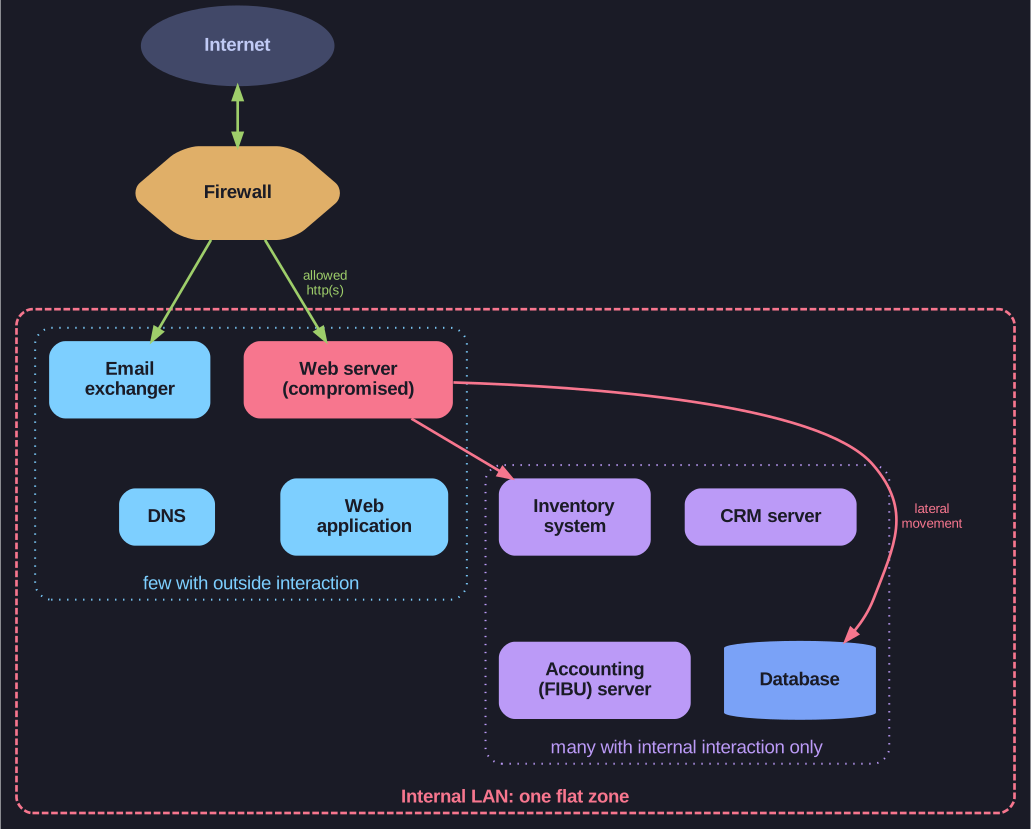
* A few servers face the internet, but they share one flat LAN with everything that should never be reachable from outside. *
A perimeter only knows "inside" and "outside". As more business cases required an internet presence or active participation on the internet, more inside systems needed holes in the firewall so the outside could reach them. Each hole lands inside the trusted zone. The development reached a first peak during the dot-com boom around 2000, when almost every company put a website, a mail exchanger and public DNS online.
The problem is the mismatch of exposure: a web server is attacked all day long, while the accounting (FIBU, Finanzbuchhaltung) server never needs to talk to the internet at all. Putting both in one flat zone means the security of the accounting server is only as good as that of the web server. This is the flat perimeter anti-pattern applied to internet services, and the idea of the DMZ grew out of exactly this motivation.
Go deeper:
 Lateral movement (cybersecurity) — Wikipedia — how an attacker spreads from one foothold through a flat network.
- Dot-com bubble — Wikipedia — the late-1990s rush online that put internet-facing servers into every company.