Which online behaviour is an officially recognised disorder, and what does the ICD-11 require for the diagnosis?
Apart from gambling disorder, only gaming disorder is recognised (in ICD-11). It requires loss of control, giving gaming priority over other interests and duties, and continuing despite negative consequences, with significant distress or impairment, normally for at least 12 months.
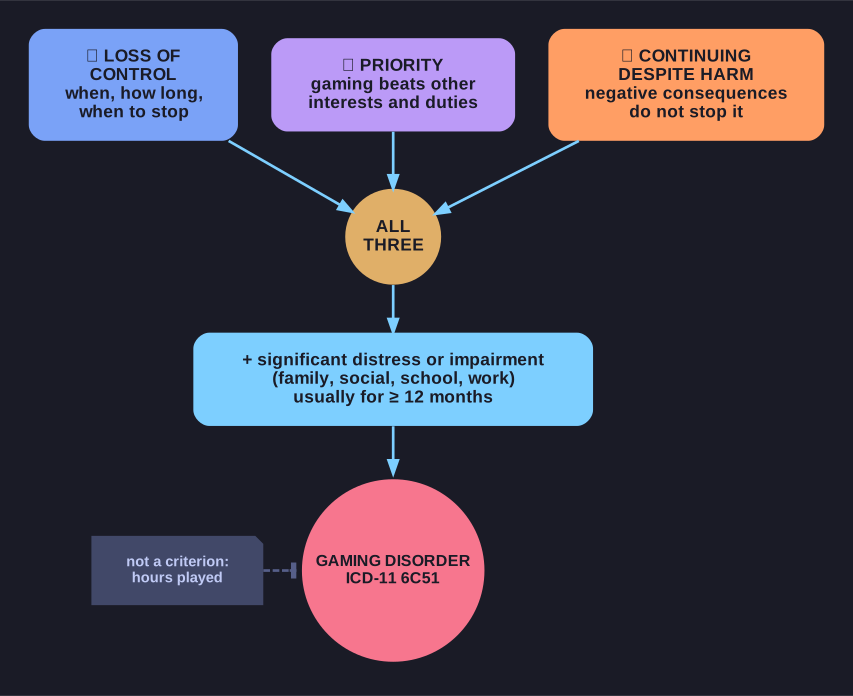
* All three criteria plus significant distress are needed *
The definition of "computer game addiction" has been sharpened step by step until clear criteria existed. The ICD-11 diagnosis needs all of:
- Loss of control (Kontrollverlust): over when, how often and how long one plays, and when one stops.
- Priority (Priorisierung): gaming increasingly takes precedence over other interests and daily activities.
- Continuation despite negative consequences: gaming goes on, or increases, although it clearly causes harm.
- With significant distress (Leidensdruck) or impairment in personal, family, social, school or work life, normally visible for at least 12 months.
Note what is not a criterion: the number of hours played. A professional e-sports player can play ten hours a day without loss of control.
In the DSM-5, "Internet Gaming Disorder" is only listed as a condition for further research. Whether other internet behaviours, such as excessive use of social networks, are also behavioural addictions is still being debated.
Go deeper:
 WHO: Addictive behaviours — gaming disorder — the WHO's own explanation of the ICD-11 criteria.
- Wikipedia: Video game addiction — research, the ICD-11 and DSM-5 positions, and criticism.