Question
Why does a serious discussion of addiction start with the human desire for intoxication (Rausch) rather than with the addiction itself?
Answer
Because the wish for intoxication is ancient and normal, and every addiction begins as unproblematic, even enjoyable consumption. Addiction is the far end of a path (Rausch → enjoyment → excessive use → addiction), not a separate kind of person.
The path has four stages: the desire for intoxication (Wunsch nach Rausch), enjoyment (Genuss), excessive, problematic consumption or behaviour, and finally addiction (Suchtproblematik). Most people stay at the first two stages for their whole life.
The desire is as old as humanity:
- Regular use of psychoactive plants may have started 16,000 to 25,000 years ago, long before agriculture (evidence from the remains of two hunter-gatherers found on the Indonesian island of Sulawesi).
- In the Epic of Gilgamesh (around 2000 BC), the wild man Enkidu drinks seven jugs of an intoxicating drink, becomes cheerful, washes, anoints himself and so "becomes a human". Intoxication is part of being civilised, not its opposite.
- Poets such as Wolfgang Borchert praised being intoxicated "by spirit, blood and vines".
The philosopher Robert Pfaller puts the ethical point sharply: always being reasonable is no sign of actually being reasonable; only when we do unreasonable things (dance, drink, fall in love) do we feel that life is worth living.
So the ethical task is not to moralise pleasure away. It is to understand at what point, and through which individual and social factors, a normal human desire tips into something that harms the person and those around them.
Go deeper:
 Wikipedia: Psychoactive drug — history of human use of mind-altering substances.
- Wikipedia: Gilgamesh — the epic in which Enkidu is "humanised" by bread and drink.
Note saved — thanks!
Question
What do the dopamine and serotonin systems do, and how does a game like Candy Crush use the reward system?
Answer
Dopamine drives reward and motivation, joy and euphoria (and fine-tunes movement); serotonin regulates mood, memory processing, sleep and cognition. Candy Crush rewards every action with visual and sound praise, which activates the dopamine system.
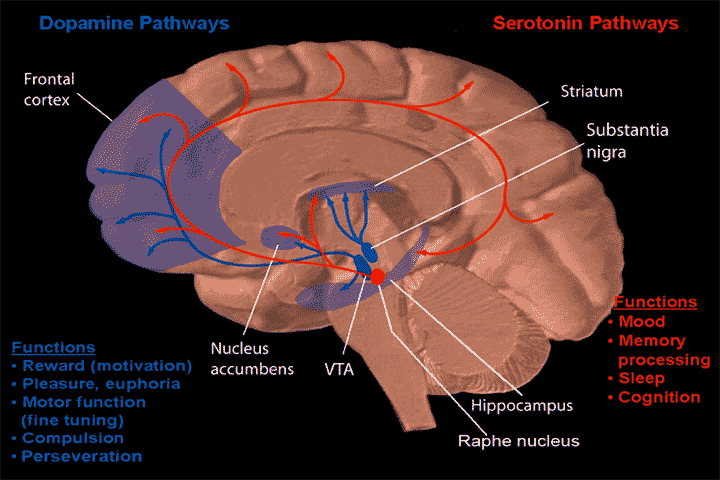
* Dopamine pathways (blue) run from the VTA to the nucleus accumbens, striatum and frontal cortex; serotonin pathways (red) start in the raphe nucleus — NIH, public domain, via Wikimedia Commons *
Together these systems form the brain's reward system (Belohnungssystem):
| System | Starts in | Functions |
|---|---|---|
| Dopamine | VTA (ventral tegmental area), substantia nigra | reward (motivation), joy and euphoria, fine-tuning of movement |
| Serotonin | raphe nucleus | mood, processing of memories, sleep, cognition |
Dopamine is less a "pleasure molecule" than a "want more" signal: it marks what was worth doing so that we do it again. Anything that fires it reliably and cheaply becomes attractive to repeat.
Candy Crush exploits this with an illusion of competence: every match produces a flash, a sound or a word of praise ("Sweet!"), so the player feels skilful even when progress is largely luck. Each little reward activates the dopaminergic system, and the game is built so that these rewards come quickly and often. This is the basic mechanism behind "addiction by design".
Go deeper:
 ARTE: Dopamin — Candy Crush — short documentary on how the game triggers the dopamine system (German).
- Wikipedia: Reward system — the brain structures and how addiction hijacks them.
Note saved — thanks!