Which layers of influence on addictive behaviour does the National Strategy on Addiction distinguish?
Four nested layers around the individual (who brings genes, age and sex): personal behaviour, the social environment, living and working conditions, and the wider social, economic, ecological and cultural conditions.
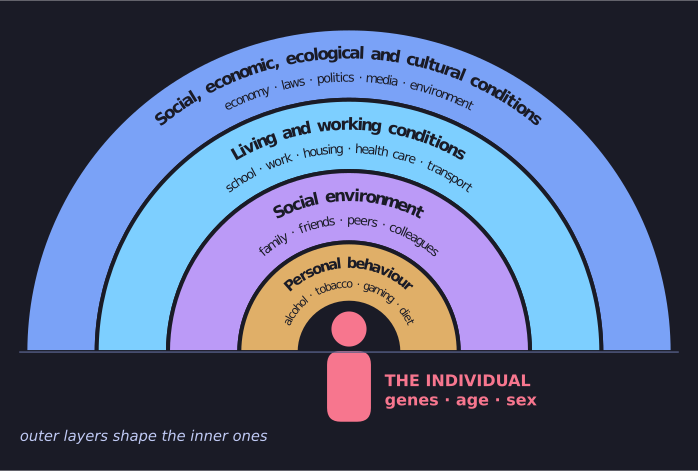
* From the innermost layer (own behaviour) to the outermost (society as a whole) *
From the inside out (gesellschaftliche Rahmenbedingungen, "societal framework conditions"):
- The individual: genetic make-up (Erbanlagen), age and sex. These cannot be changed.
- Personal behaviour (persönliches Verhalten): diet, exercise, alcohol, tobacco, drugs, gambling and gaming.
- Social environment (soziales Umfeld): family, friends, peers, colleagues.
- Living and working conditions (Lebens- und Arbeitsbedingungen): education, work, housing, health care, transport, culture and leisure.
- Social, economic, ecological and cultural conditions: the economy, laws, politics, media, the environment.
The model closely resembles the classic "rainbow" of health determinants by Dahlgren and Whitehead. Its ethical message: if outer layers shape behaviour, responsibility for addiction cannot be put on the individual alone. Prevention therefore works on every layer, from personal skills to advertising laws.
Go deeper:
 Wikipedia: Social determinants of health — the general model of layered health influences.