What is the task of a DMZ, and what is the Rückwirkungs-Risiko it is meant to keep small?
The DMZ offers a place for servers that provide services to external networks (generally the internet), while keeping the risk of repercussions on the internal systems (LAN, backend servers, internal networks) as small as possible. Restrictively configured firewalls are placed between the zones to achieve this.
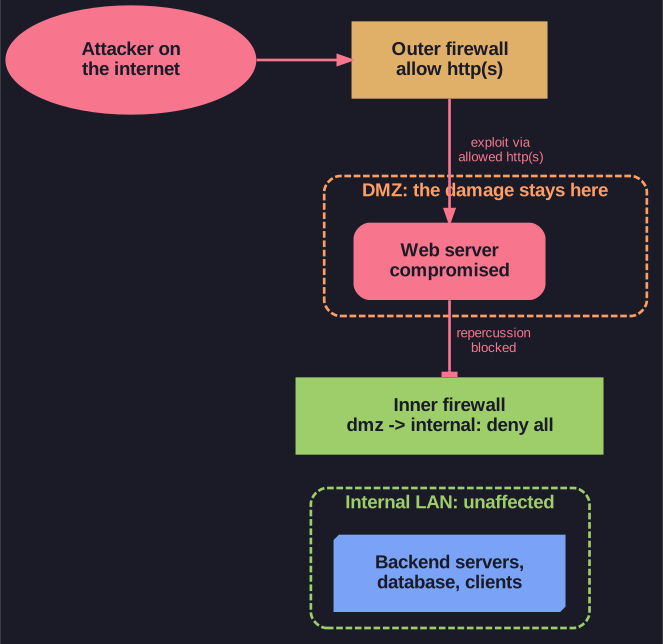
* A compromised DMZ server stays a DMZ problem: the inner firewall stops the attack from reaching the LAN. *
Rückwirkung means a repercussion or effect that flows back. The Rückwirkungs-Risiko is the risk that something happening to the exposed servers (a compromise, a malware infection, an overload) spills back onto the internal systems behind them. The DMZ does not try to make the web server unbreakable; it accepts that internet-facing systems are the most attacked ones and limits what a successful attack can reach.
That is why the firewalls between the zones are restrictive: every rule that lets the DMZ talk to the LAN is a path along which a repercussion could travel, so there should be as few as possible, ideally none.
Go deeper:
 Defense in depth (computing) — Wikipedia — layered controls so that one broken layer does not expose everything.
- MITRE ATT&CK TA0008 — Lateral Movement — the techniques the inner DMZ firewall is there to stop.