Quiz Entry - updated: 2026.10.22
What is the Swiss four-pillar model of addiction policy?
The basis of the Narcotics Act (BetmG): the federal government and cantons act in four areas at once: prevention, therapy and reintegration, harm reduction and survival aid, and regulation and enforcement.
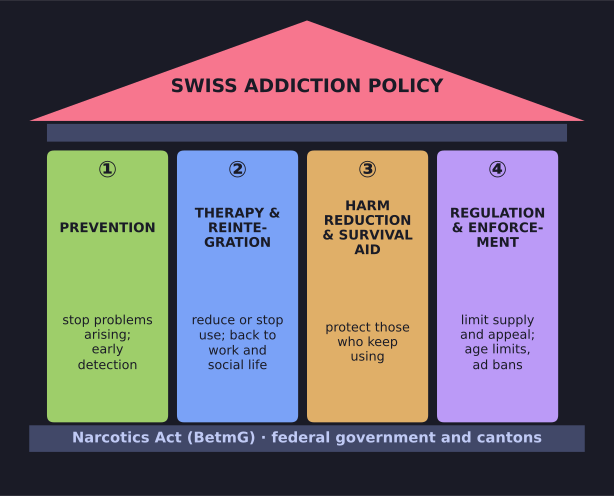
* Four pillars carry one policy; none is enough on its own *
| Pillar | German | Aim |
|---|---|---|
| Prevention | Prävention | stop problems from arising; health promotion and early detection |
| Therapy and reintegration | Therapie und Wiedereingliederung | help dependent people reduce or stop and return to work and social life |
| Harm reduction and survival aid | Schadenminderung und Überlebenshilfe | limit damage for people who keep using, e.g. clean needles, supervised consumption rooms, emergency shelters |
| Regulation and enforcement | Regulierung und Vollzug (formerly "repression") | limit availability and appeal, e.g. age limits, advertising bans, policing illegal markets |
The model grew out of the heroin crisis of the 1980s and 1990s (open drug scenes such as Zurich's Platzspitz). Its ethically important pillar is harm reduction: it accepts that some people will keep using and protects their life and health anyway, instead of making abstinence the precondition for help. It was later anchored in the revised Narcotics Act.
Go deeper:
 BAG: Vier-Säulen-Politik — the official description of the four pillars and the cube model (German).
- Wikipedia: Drug policy of Switzerland — history of the four-pillar policy and heroin-assisted treatment.
- Wikipedia: Harm reduction — the principle behind the third pillar.