What is a verifiable presentation (VP), and how does it differ from a verifiable credential?
A VP is created by the holder and wraps one or more VCs, possibly from several issuers, together with presentation metadata and optional proofs; a VC is created and signed by an issuer.
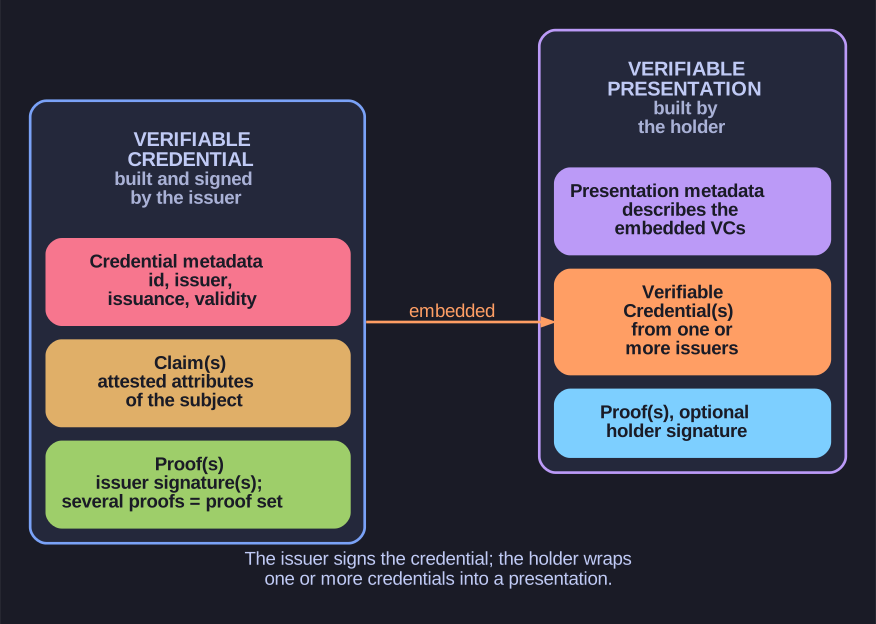
* The issuer signs the credential; the holder wraps one or more credentials into a presentation. *
| Verifiable credential | Verifiable presentation | |
|---|---|---|
| Created by | Issuer | Holder |
| Contains | Claims about a subject | One or more VCs (or data derived from them) |
| Sources | One issuer | One or more issuers |
| Metadata | Credential metadata (issuer, validity) | Presentation metadata describing the structure of the embedded VCs |
| Proof | Issuer signature, mandatory | Holder signature, optional |
| Lifetime | Long-lived, stays in the wallet | Built fresh for one verifier, one occasion |
The VP exists because the verifier rarely wants exactly one complete credential. A car rental might want your identity and your licence: the holder bundles both VCs into one presentation. The optional holder proof lets the holder show that the presentation was made by them now, for this verifier, which prevents someone from simply replaying an intercepted presentation.
Go deeper:
 W3C VC Data Model 2.0: Verifiable presentations — how presentations wrap credentials, with JSON examples.