Question
What is the vision behind self-sovereign identity (SSI), and where does it sit in the evolution of digital identity?
Answer
SSI is the step beyond user-centric identity: the user is central to the administration of their own identity and controls it across any number of authorities, without depending on one provider.
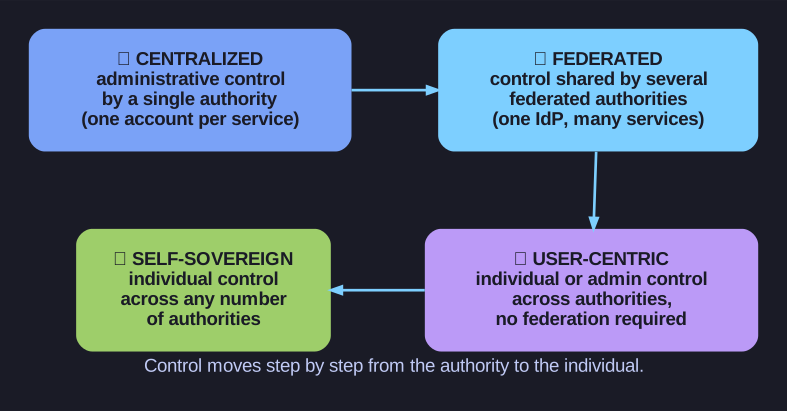
* Allen's four phases: control moves step by step from the authority to the individual. *
The idea was popularised by Christopher Allen's essay The Path to Self-Sovereign Identity (written in 2016). He tells the history of online identity as four phases, each moving control a little further from the authority towards the individual:
- Centralised identity: one authority (one website, one CA, one registry) issues and controls your account. Lose its favour, lose your identity.
- Federated identity: several authorities agree to trust each other, so one login works at partner sites. Control is still with the federation, not with you.
- User-centric identity: you can use one identity across many services without a formal federation (OpenID, social logins). In practice the identity still lives with a provider who can see and revoke it.
- Self-sovereign identity: the individual holds and controls the identity and decides where to use it, across any number of authorities.
His key sentence: "the user must be central to the administration of identity." SSI starts from the same place as user-centric identity but removes the remaining dependence on a provider that sits in the middle.
Go deeper:
 Christopher Allen: The Path to Self-Sovereign Identity — the original essay, with the four phases of online identity told in full.
- Self-sovereign identity (Wikipedia) — background, technical building blocks and the concerns raised against SSI.
Note saved — thanks!
Question
What are the two defining properties of a self-sovereign identity in its original, strict sense?
Answer
- The user owns their electronic identity and so holds their own personal data, never a central service or a state issuer.
- There is no central store of identity data, only confirmations (attestations) in public, decentralised registers.
The first property is about ownership and control: the identity data sits with the person, typically in a wallet on their device. No provider keeps a master copy that it could read, sell, lose in a breach or switch off.
The second property is about architecture: something still has to let a stranger check that a claim is genuine. In SSI that "something" is a public, decentralised register that holds only what is needed for verification (for example the public keys of issuers), never the personal data itself.
Note how strict the vision is: it excludes even a state as the owner of your identity. The pragmatic version used today (see the next cards) relaxes this: a state may well issue the credential, as long as the holder keeps it and the issuer is not involved when it is used.
Go deeper:
- Self-sovereign identity (Wikipedia) — how the strict definition meets real national identity systems, including the EU's.
Note saved — thanks!