What does "decoupling of issuance and use" mean in SSI, and why does it matter?
After issuing a credential, the issuer is not involved when it is used, except for revocation checks, so it cannot see where, when or how often the holder presents it.
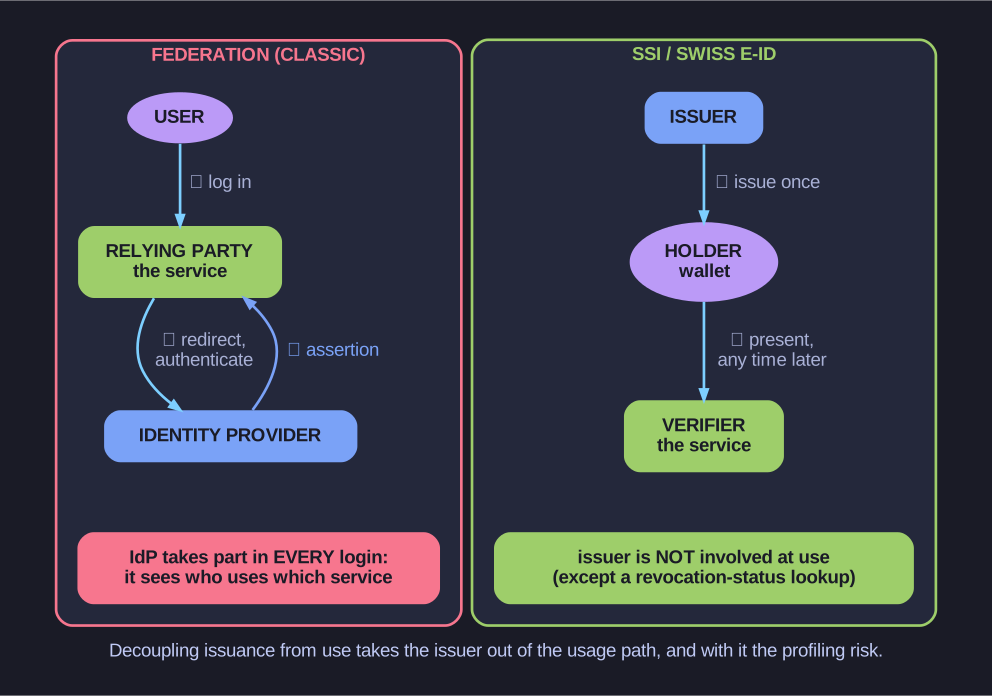
* Decoupling issuance from use takes the issuer out of the usage path, and with it the profiling risk. *
Compare the two models:
- Classic federation: every login at a relying party is redirected to the identity provider. The IdP takes part in every access and therefore sees every access, which is the basis for profiling.
- SSI / Swiss E-ID: the issuer hands the credential to the holder once. Later the holder presents it directly to verifiers. The issuer learns nothing about these presentations.
The one remaining touchpoint is revocation: a verifier must find out whether a credential has been revoked. It is designed so that this lookup does not reveal which credential is being checked, for example by fetching a whole status list rather than asking about one credential.
This decoupling is the central privacy gain of SSI over federated identity, and the Swiss E-ID provides it.
Go deeper:
 e-ID: Technologie (eid.admin.ch) — states that the issuer does not learn of presentations (in German).