What does a Swiss survey on who should pay for treatment reveal about how the public sees addiction?
Addiction is judged far more harshly than other illnesses: 47% of voters think people with drug dependence should pay for treatment themselves, while only 2% say so for psychological complaints and 1% for rare diseases. Addiction is still widely seen as self-inflicted rather than as a disease.
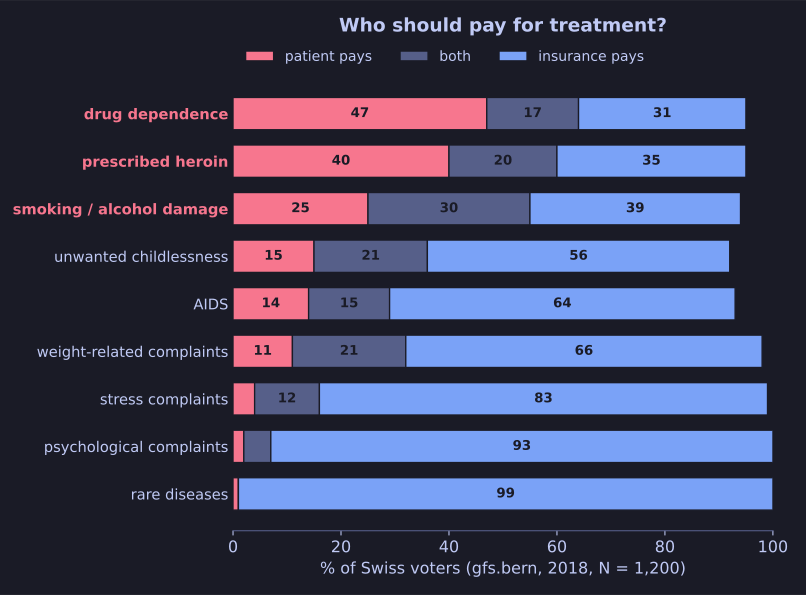
* Addiction-related items top the "pay yourself" column *
In the gfs.bern Gesundheitsmonitor 2018 (1,200 Swiss voters), people were asked, for a list of conditions, whether the patient should pay or the compulsory basic health insurance (Grundversicherung):
| Condition | Patient pays | Both | Insurance pays |
|---|---|---|---|
| drug dependence | 47% | 17% | 31% |
| medically prescribed heroin | 40% | 20% | 35% |
| damage from smoking or alcohol | 25% | 30% | 39% |
| unwanted childlessness | 15% | 21% | 56% |
| psychological complaints | 2% | 5% | 93% |
| rare diseases | 1% | 0% | 99% |
The ethical tension: medicine and the WHO class addiction as a disease, but much of the public applies a guilt logic ("you did it to yourself"). That stigma makes people hide problems and seek help late, and it shapes political will to fund prevention and treatment.
Go deeper:
 Wikipedia: Disease model of addiction — the disease view versus the moral view of addiction.