What do the dopamine and serotonin systems do, and how does a game like Candy Crush use the reward system?
Dopamine drives reward and motivation, joy and euphoria (and fine-tunes movement); serotonin regulates mood, memory processing, sleep and cognition. Candy Crush rewards every action with visual and sound praise, which activates the dopamine system.
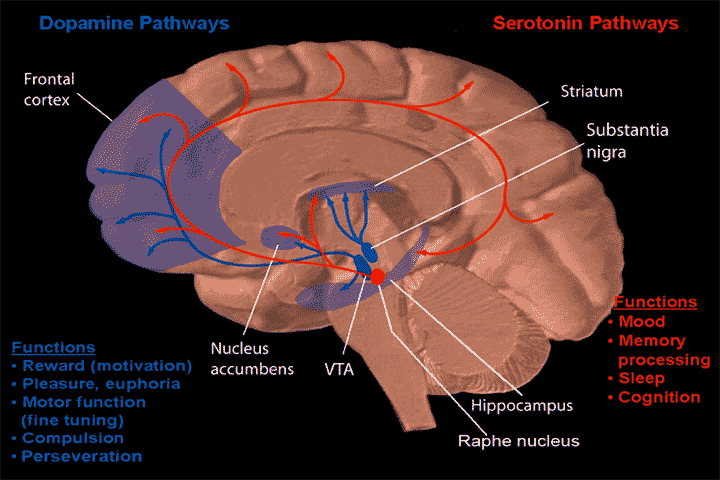
* Dopamine pathways (blue) run from the VTA to the nucleus accumbens, striatum and frontal cortex; serotonin pathways (red) start in the raphe nucleus — NIH, public domain, via Wikimedia Commons *
Together these systems form the brain's reward system (Belohnungssystem):
| System | Starts in | Functions |
|---|---|---|
| Dopamine | VTA (ventral tegmental area), substantia nigra | reward (motivation), joy and euphoria, fine-tuning of movement |
| Serotonin | raphe nucleus | mood, processing of memories, sleep, cognition |
Dopamine is less a "pleasure molecule" than a "want more" signal: it marks what was worth doing so that we do it again. Anything that fires it reliably and cheaply becomes attractive to repeat.
Candy Crush exploits this with an illusion of competence: every match produces a flash, a sound or a word of praise ("Sweet!"), so the player feels skilful even when progress is largely luck. Each little reward activates the dopaminergic system, and the game is built so that these rewards come quickly and often. This is the basic mechanism behind "addiction by design".
Go deeper:
 ARTE: Dopamin — Candy Crush — short documentary on how the game triggers the dopamine system (German).
 Wikipedia: Reward system — the brain structures and how addiction hijacks them.