How does the cube model (Würfelmodell) extend the four-pillar model?
It adds a second dimension, the three consumption patterns (low-risk use, problematic use, dependence), and a third, the substances and behaviours. The result is a cube in which each measure is placed by pillar × pattern × substance, and it applies across all substances, legal or illegal, and to behavioural addictions.
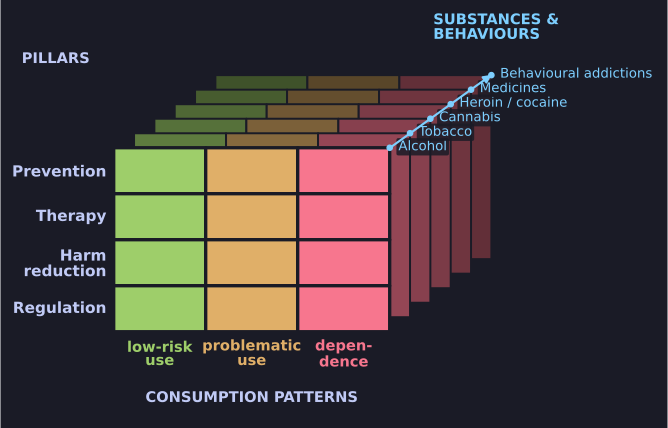
* Every pillar is applied to every consumption pattern, for every substance or behaviour *
The three axes:
- Pillars: prevention, therapy, harm reduction, regulation (in the cube's original drawing still labelled "repression").
- Consumption patterns: low-risk use (risikoarmer Konsum), problematic use (problematischer Konsum), dependence (Abhängigkeit).
- Substances and behaviours: alcohol, tobacco, cannabis, synthetic drugs, heroin, cocaine, psychoactive medicines and behavioural addictions (Verhaltenssüchte).
Why the extension matters: the original four pillars were built for illegal drugs and for dependent users. The cube says the same logic applies to every substance and behaviour (substanzübergreifend, "across substances"), and that measures must fit the pattern: low-risk users need prevention and fair regulation, not therapy; dependent users need therapy and harm reduction. It was proposed by the Federal Commission for Drug Issues and underlies the National Strategy on Addiction.
Go deeper:
 BAG: Vier-Säulen-Politik — explains the cube extension and the three consumption patterns (German).