Question
Why does Ansible use variables, and what rules does a variable name have to follow?
Answer
Variables store values once and reuse them across a project, so playbooks are easier to write and maintain, less error-prone, and adaptable to different environments. A name must start with a letter and contain only letters, digits and underscores.
Without variables, the same value (a package name, a path, a port) is typed into every task that needs it. Change it and you have to find every copy; miss one and the hosts drift apart. With a variable, the value lives in one place and every task refers to it, so one edit changes them all. The same playbook can also run against test and production with different values, because only the variables differ, not the tasks.
Typical things to put in variables:
- users to create
- packages to install
- services to restart
- files to remove
- archives to download
| Name | Valid? | Why |
|---|---|---|
web_package |
yes | letters and an underscore |
port80 |
yes | digits are fine after the first letter |
80port |
no | starts with a digit |
web-package |
no | a hyphen is not allowed (Jinja2 would read it as a minus) |
web package |
no | no spaces |
Go deeper:
 Using variables: creating valid variable names (official docs) — the naming rules and the keywords you must not use as names.
 Ansible 101, Episode 5: handlers, environment vars and variables (Jeff Geerling) — variables in a running project.
- Ansible (software) (Wikipedia) — background on the tool and its architecture.
Note saved — thanks!
Question
Where can a variable be defined in Ansible, and which definition wins if the same name is set in several places?
Answer
From lowest to highest priority: group variables in the inventory, group_vars files, host variables in the inventory, host_vars files, gathered facts, play variables (vars, vars_files), task variables, and extra variables on the command line. The higher one overrides; the rule of thumb is "more specific beats more general".
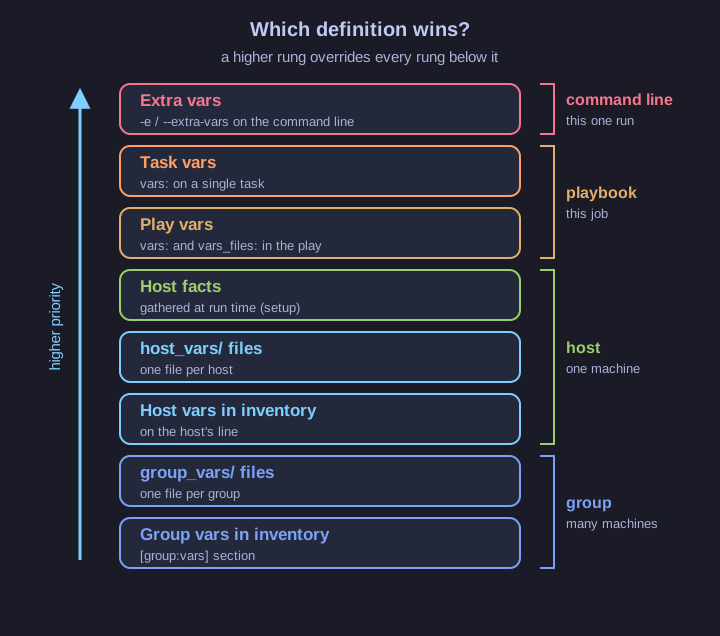
* Higher rungs override lower ones; extra vars (-e) always win. *
The ladder follows two ideas:
- Narrow beats broad. A value for one host is more specific than a value for a whole group, and a value for one task is more specific than one for the whole play. So host variables beat group variables, and task variables beat play variables.
- Closer to the run beats further away. The inventory describes the environment; the playbook describes this job; the command line describes this one run. That is why
--extra-vars/-eoverrides everything: it is the operator saying "for this run, use this value".
In short: inventory variables < playbook variables < extra variables.
Precedence can be used on purpose (a group default that one special host overrides). Where you don't need that, give variables unique names, so there's never a question of which definition wins.
Go deeper:
- Variable precedence: where should I put a variable? (official docs) — the full 22-step list, of which this is a simplified version.
- Controlling how Ansible behaves: precedence rules (official docs) — how variables fit in with config settings and command-line options.
Note saved — thanks!