You have only a photo — no caption, no location. How do you work out where it was taken?
Mine the picture itself for location clues — signs and language, architecture, vehicles, nature — form a hypothesis, then confirm it with reverse image search or Google Lens.
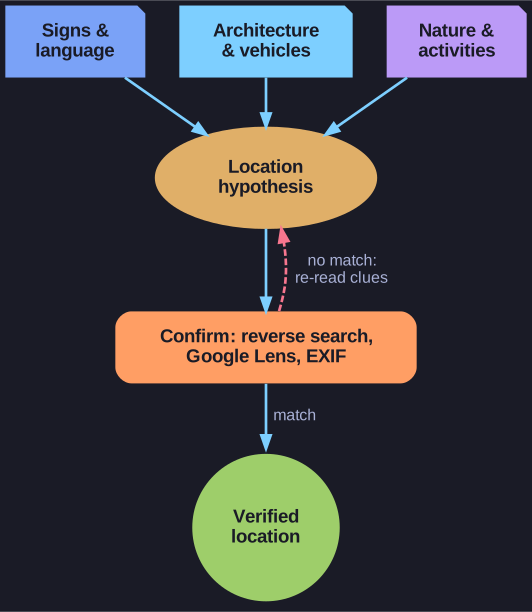
* Three clue families feed a hypothesis; tools confirm it — or send you back to the frame. *
The image is its own evidence locker; geolocating it is a two-step loop:
- Read the clues in the frame. Written language on shopfronts and boats, architectural style (shuttered Mediterranean facades vs alpine timber), vehicle types and number plates, vegetation and weather, distinctive activities. Example: a harbour photo showing long rowing boats with jousting platforms and the lettering "Ville de Sète" on a hull — French text, southern-French facades, and water-jousting boats point to Sète, the town in southern France famous for exactly that tournament.
- Confirm with tools. Feed the photo (or a cropped landmark from it) to Google Lens or a reverse image search: a match on the same quay or the same event turns the hypothesis into a verified location. Image metadata (EXIF, which can embed GPS coordinates) settles it instantly when present — but social platforms strip it on upload, so the visual method is the one that reliably works.
The deeper point is the provenance mindset: a photo's claimed location is just another claim, and the picture usually contains enough internal evidence to check it independently.
Tip: Start with any text in the image — language plus a searchable proper name (a shop, a boat, a street) is usually the fastest route to a verifiable place.
Go deeper:
 Bellingcat — A beginner's guide to geolocating videos — the open-source-investigation classic on exactly this clue-and-confirm method.
- Water jousting — the Sète tradition behind the example photo, clue by clue.