Worked example: the owner of a fleet management application wants the IAM to supply each employee's driving licence and vehicle class. How does the scope check decide, and why can it come out either way?
The IAM weighs how many people need it, how relevant it is to the business processes, how important it is to the company and what regular licence checks would cost; in a company where fleet is a fringe topic the answer is "solve it in the application", in a fleet-management company it is "qualitative extension".
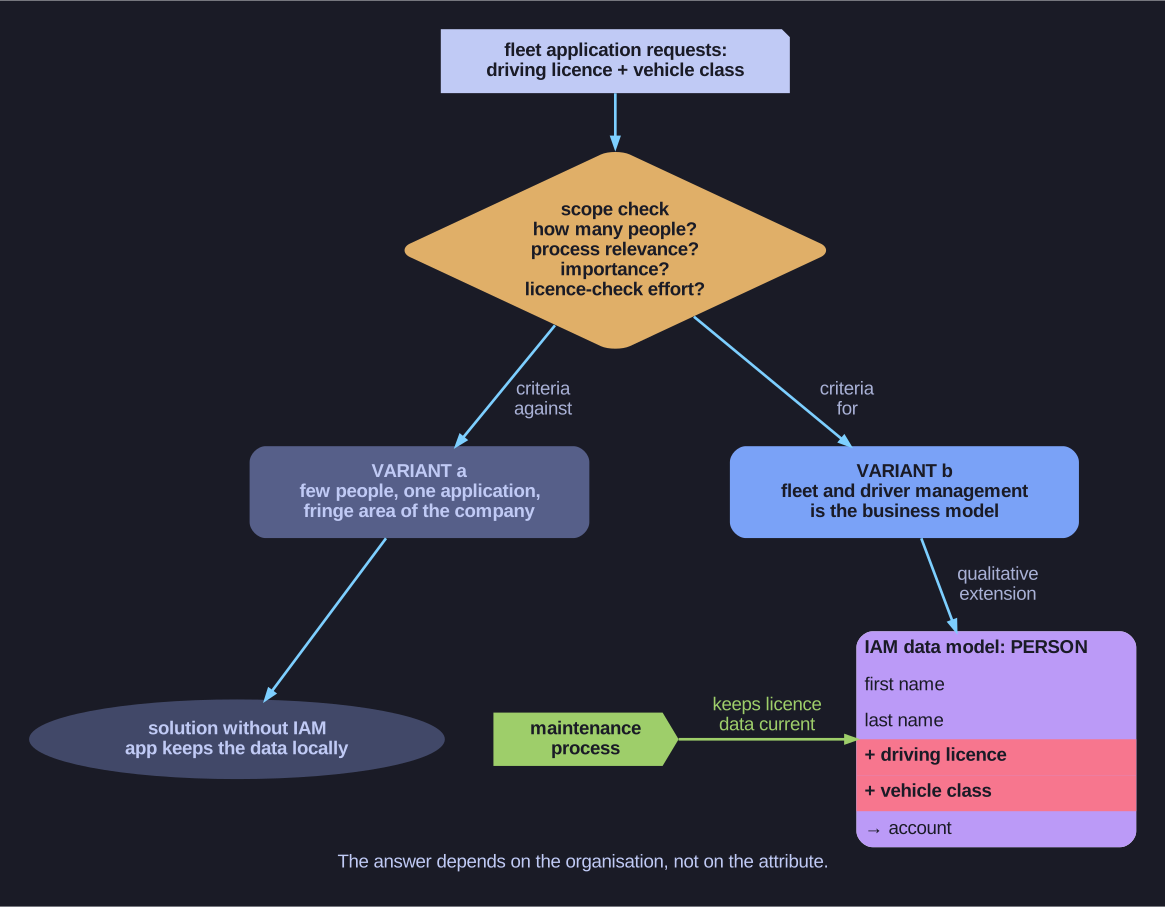
* The same request, two companies, two correct answers. *
The request sounds simple: two new attributes, driving licence and vehicle class, on the person object. But the IAM has to ask:
- Effort: driving licences expire and can be withdrawn, so a regular licence check process would be needed to keep the data true.
- How many people need this?
- Process relevance: which business processes depend on it?
- Importance for the company?
Variant a: only a few people drive company cars, only the fleet tool needs the data, and fleet is a fringe area of the company. The criteria point against an extension, so the result is a solution without IAM: the fleet tool records and checks licences itself. (The application owner is not happy, but it is the right call.)
Variant b: the company's business model is fleet and driver management. Quantity, importance and relevance all speak for it, so the result is a solution with IAM, a qualitative extension: the business data model gains licence and class under person, and a maintenance process (Pflege) is set up that keeps these attributes current.
The lesson is that the scope check is not a property of the attribute; it depends on the organisation.
Go deeper:
 Fleet management (Wikipedia) — what fleet management covers, from licensing and compliance to driver management.