Worked example: salaries are paid at the end of the month, HR enters new employees some time during the month, but IAM services should work from the first working day. What is the timeliness problem, and why does it arise?
HR's maintenance rhythm is driven by payroll at month-end, so a new hire's record may only be entered after they have started; the IAM, fed from that record, cannot create the person and account in time for day one.
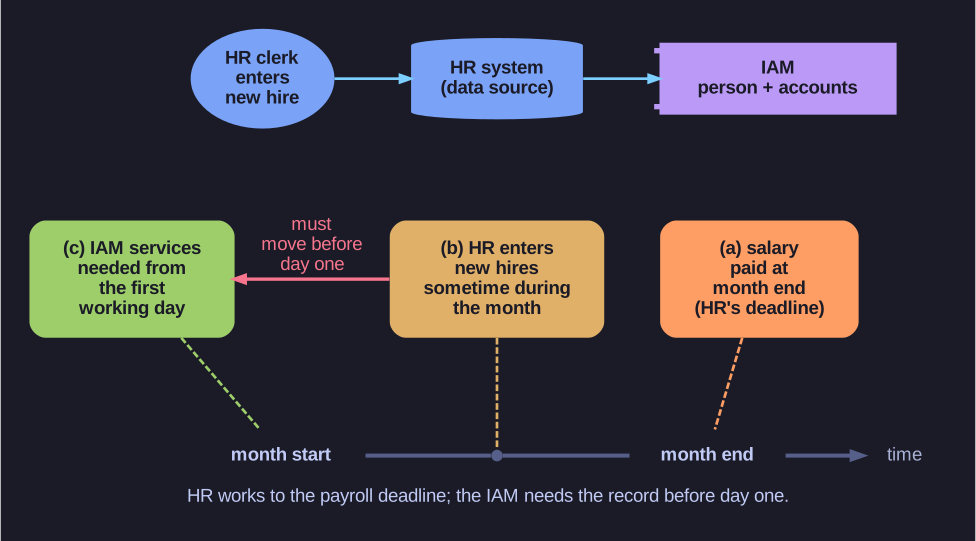
* HR's deadline is payroll at month-end; IAM's deadline is day one. *
The setting: the HR system is the data source for employees. An HR clerk enters each new hire, and the IAM creates the person and their accounts from that record. Three facts collide:
- a. Salary is paid at the end of the month. That is HR's real deadline: as long as the record exists before the payroll run, HR has done its job.
- b. So data entry for new employees happens at some point during the month, often after the person has already started.
- c. But the IAM services (login, e-mail, applications) should be usable from the first working day, which is usually the start of the month.
The IAM cannot be more current than its source. If the record arrives on the 15th, the new employee spends two weeks without an account, borrowing a colleague's login, which is a security problem in itself. The root cause is not technical: the source's maintenance process is optimised for a different consumer. That is why timeliness (Aktualität) must be explicitly agreed in the data delivery agreement, and sometimes why the source's process itself has to change, for example entering hires before their start date.
Go deeper:
 Microsoft: What is HR-driven provisioning? — HR as the source for accounts, including joiner workflows that depend on timely HR data.
- Data quality (Wikipedia) — timeliness as a dimension of data quality, judged against the consumer's needs.