Worked example: company F sells its products through partners P1 and P2, whose staff already get IAM accounts. Why is adding a third sales partner P3 a quantitative extension, and what has to be done?
P3's employees are the same kind of data (persons who need accounts for F's applications) the IAM already handles for P1 and P2; only a new source, P3's data source DQ3, has to be connected.
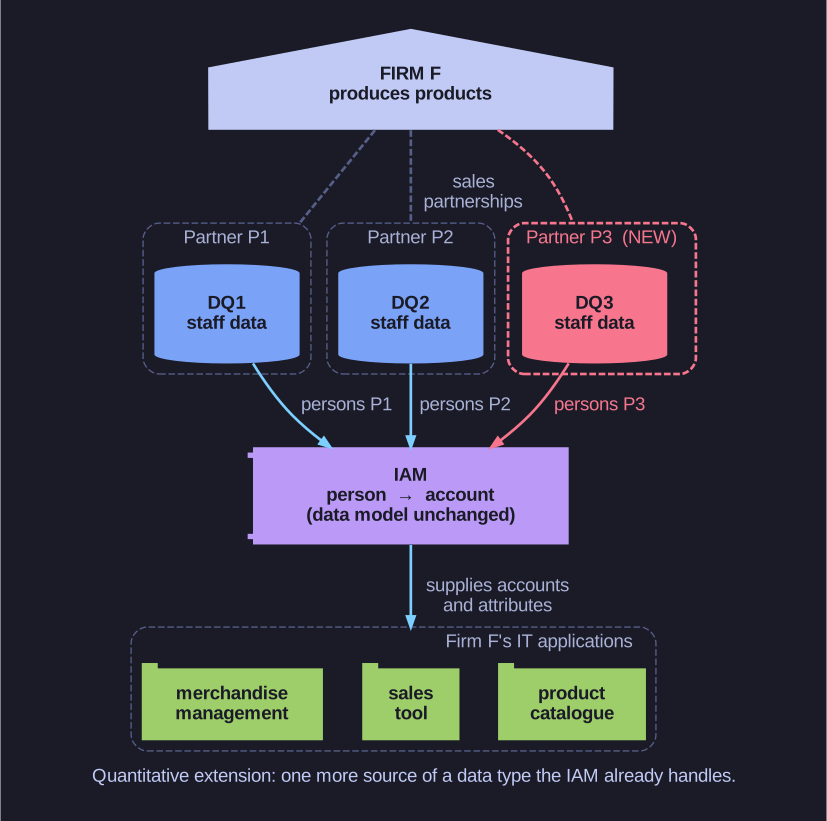
* A third partner adds a third data source of the same kind; the IAM data model does not change. *
The setting: firm F produces products, and sales partners distribute them under sales partnership contracts. Partner staff need to use F's IT applications (product catalogue, sales tool, merchandise management). Each partner runs its own data source with its staff (DQ1 at P1, DQ2 at P2). These sources deliver person records to F's IAM, which creates a person and an account for each and supplies the applications.
Now F signs a third partnership with P3. P3's sales staff need exactly what P1's and P2's staff have. Nothing about what the IAM stores changes; only who is in it. So the work is the short, standard path:
- Find the person responsible for P3's data source.
- Conclude a data delivery agreement (DLV) with them, covering content, quality, timeliness and data protection.
- Set up the technical connection from DQ3 to the IAM.
Because P1 and P2 were connected the same way, the agreement and connector can largely be copied from a template, which is exactly why quantitative extensions should be standardised.
Go deeper:
 Microsoft Entra: B2B collaboration overview — the alternative to importing a partner's source: inviting partner staff as guests who sign in with their own accounts.