Why is business-to-business data exchange usually handled by data gateways rather than connecting the partners' backend systems directly?
Because the backend systems often lack the needed protocols and APIs, the exchange needs extensive conversions between protocol variants, versions and subtypes, and the transport varies across every common network protocol. Data gateways take over this work: connecting the internal servers, converting, and talking to the partners over the network.
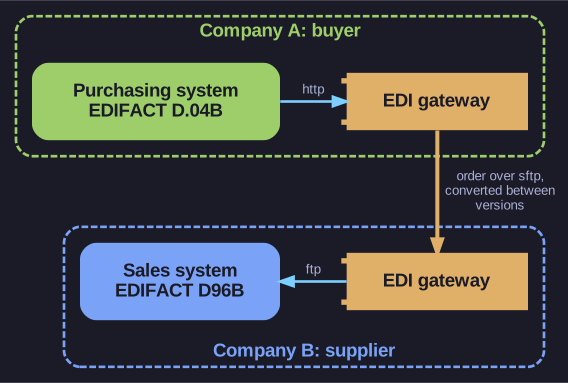
* Neither backend talks to the other directly: each side's gateway converts the order and carries it. *
Server-to-server exchange across company borders keeps growing with digitalisation. A whole protocol family is grouped as EDI (Electronic Data Interchange); standard formats include SWIFT in banking and EDIFACT for general business data, and newer approaches use standard XML formats. All of them aim to make B2B exchange easier.
For example, buyer A's purchasing system speaks EDIFACT version D.04B over HTTP, supplier B's sales system expects D96B over FTP. An EDI gateway on each side converts the order and carries it over SFTP between the companies. Neither backend needs to know anything about the other. There are as many gateway vendors as formats.
Go deeper:
 Electronic data interchange — Wikipedia — the B2B exchange standards data gateways speak.
- EDIFACT — Wikipedia — the UN standard, its message structure and versions.
- SWIFT — Wikipedia — the banking network and message standard named as an example.