Why does Ansible need privilege escalation, and how does it work on RHEL-type systems?
Tasks like installing software need root, but Ansible usually logs in as an ordinary user, so it must "become" root afterwards, by default via sudo. On RHEL 8 and 9, members of the group wheel may use sudo after entering their password.
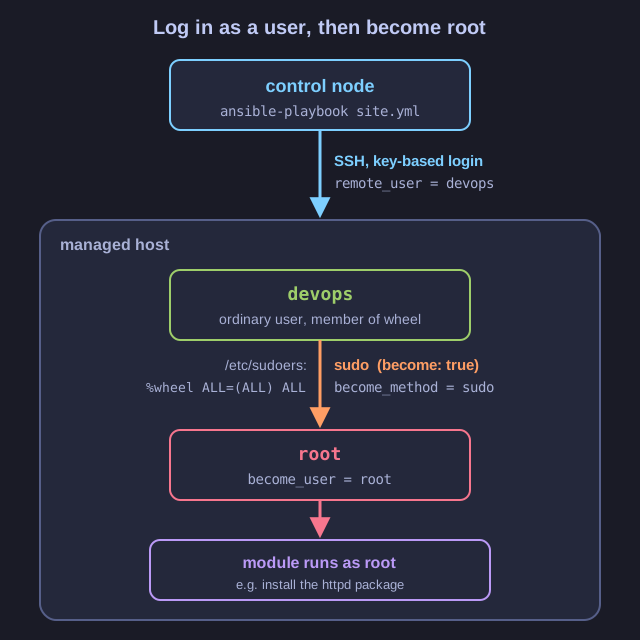
* Log in as an ordinary user, then become root only for the work that needs it. *
Logging in directly as root over SSH is usually disabled for good reason. So Ansible connects as a normal account and then escalates, exactly as an admin would type sudo dnf install httpd:
become = trueturns escalation on,become_method = sudopicks the mechanism,become_user = rootnames the target user.- Who may use sudo is defined on the managed host in
/etc/sudoers. RHEL's default line%wheel ALL=(ALL) ALLlets groupwheelrun any command as anyone, after typing their own password. - To grant extra users or groups sudo rights, drop a file into
/etc/sudoers.d/; it must be owned by root, or sudo ignores it. - If sudo asks for a password, set
become_ask_pass = trueso Ansible prompts once at the start.
The commented variant %wheel ALL=(ALL) NOPASSWD: ALL drops the password prompt. That is convenient for automation, but means anyone who gets that account's SSH key is effectively root. Which method to use is a security trade-off each organisation decides for itself.
Go deeper:
 Understanding privilege escalation: become (official docs) —
become,become_user,become_methodat config, play and task level.- Sudoers manual (sudo.ws) — the
%group host=(runas) commandssyntax andNOPASSWD. - sudo (Wikipedia) — background on sudo and the wheel group.