Why do multi-function devices (switch + router + firewall in one box) carry a particular risk for a perimeter?
The more functions one device combines, the bigger the damage that a single misconfiguration or a successful attack on its management interface can do.
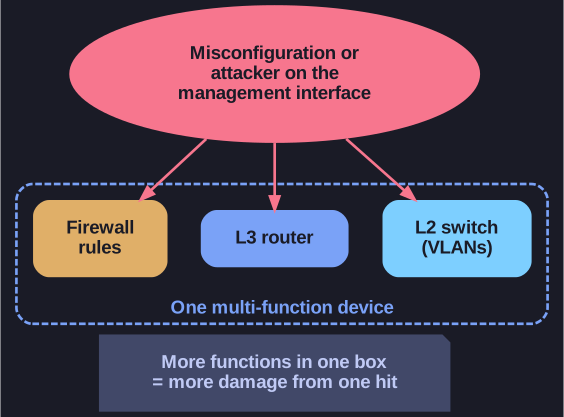
* One management interface controls every layer at once, so one mistake or breach opens all of them. *
Modern network devices often combine Layer 2 switch, Layer 3 switch/router, firewall and more. Small examples are home routers like the Fritz!Box with limited functions; large ones are modular enterprise families such as Cisco Catalyst. They are convenient and cheap to run, but they concentrate the whole perimeter in one place: whoever controls the management interface can rewire the VLANs, change the routing and rewrite the firewall rules. With separate devices, an attacker or a mistake would have to hit several boxes to open the same hole.
Go deeper:
 MITRE ATT&CK T1599 — Network Boundary Bridging — how attackers who control a network device remove the boundary it enforces.
- Cisco Catalyst — Wikipedia — the modular multi-function switch family named as the large-scale example.