Which representation of a life-cycle process suits which stakeholder, and why?
Management wants a compact overview of benefit and cost, developers want technical detail such as UML plus text and tables they can turn into tests, lawyers want text and permission tables covering data protection, consent and deletion, and project leads, architects and administrators want project plans, architecture views and technical diagrams.
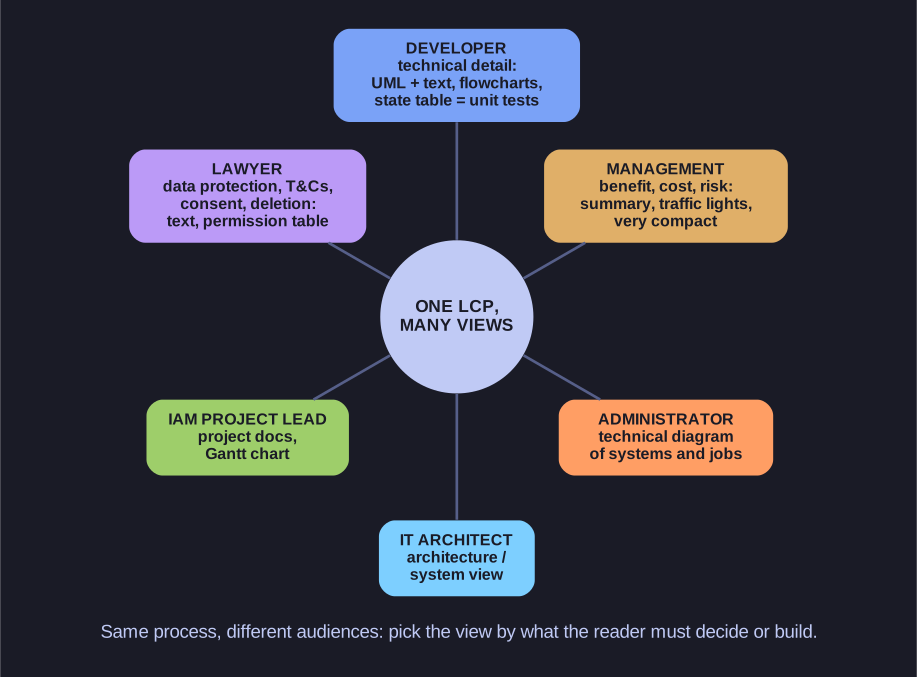
* Choose the view by what the reader has to decide or build. *
| Stakeholder | Focus | Preferred representation |
|---|---|---|
| Management | Rough overview: benefit, advantages, cost | Cost-benefit summary, management summary, traffic lights; very compact |
| Developer | Technical and detailed | UML combined with text; tables (good for unit tests); flow charts; system views |
| Lawyer | Data protection, terms and conditions, consent, also deletion | Text; tabular overview of permissions |
| IAM project lead | Planning and progress | Project documentation, Gantt chart |
| IT architect | Structure and interfaces | Architecture view |
| Administrator | Operating the systems and jobs | Diagram, possibly technical |
The principle is the same as in architecture documentation: one model, several views. A manager deciding on budget cannot use a state table, and a developer cannot implement a traffic light. More generally, an auditor wants evidence that the process is controlled and traceable (a complete state table including the irregular cases, a change history), and an IT security officer looks at the risky moments: initial passwords, completeness of deletions, orphaned accounts.
Go deeper:
 View model (Wikipedia) — describing one system through several stakeholder-specific views.
- 4+1 architectural view model (Wikipedia) — a classic scheme of logical, process, development and physical views plus scenarios.