Where along a patient's path is AI used in medicine and nursing care? Give an example for each stage.
Along four stages: prevention and prognosis (e.g. heart-rate monitoring via smartwatch), diagnosis (e.g. reading medical images), treatment (e.g. spotting drug interactions, robot-assisted surgery) and patient monitoring / aftercare (e.g. alerts when vital signs leave the normal range).
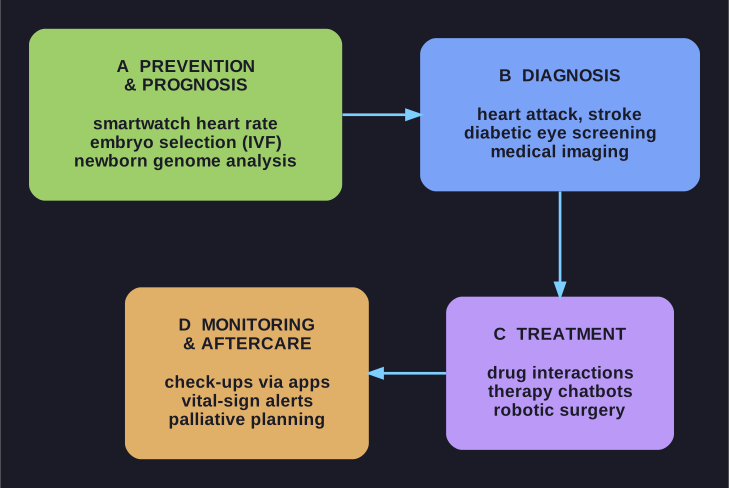
* AI applications along the patient pathway, after the Swiss doctors' association FMH (2022) *
The Swiss doctors' association (FMH, 2022) maps twelve applications:
| Stage | Examples |
|---|---|
| A. Prevention and prognosis | embryo selection in IVF; genome analysis of newborns; heart rate via smartwatch |
| B. Diagnosis | detecting a heart attack or stroke; preventing blindness in diabetic retinopathy; evaluating medical imaging |
| C. Treatment | identifying unwanted drug interactions; chatbots or apps supporting treatment of depression and anxiety; highly precise robotic surgery |
| D. Monitoring and aftercare | daily check-ups and therapy documentation via apps; warnings to staff when readings leave the normal range; predicting time of death in hospital to align palliative care |
Nursing care (Pflege) has a comparable range: monitoring vital signs (heart rate, breathing, sleep), supporting diagnoses, suggesting treatments, drawing up medication plans and logging blood sugar automatically. Translation of conversations is an extra use. So far, AI in care has mostly been discussed together with robotics.
Note how ethically loaded some items are even though they sound technical: embryo selection touches the beginning of life, and predicting the time of death touches its end.
Go deeper:
 FMH (2022): Künstliche Intelligenz im ärztlichen Alltag (PDF, German) — the brochure with the pathway figure and the FMH's demands.
- Wikipedia: Digital health — overview of digital tools across prevention, diagnosis and care.