What is the futures cone (Zukunftstrichter), and what are its classes of futures?
A cone opening from "now" to a horizon such as 2050, with nested zones: possible futures (widest) contain plausible ones, which contain probable ones. Desirable (preferable) futures are a separate, normative zone that cuts across them.
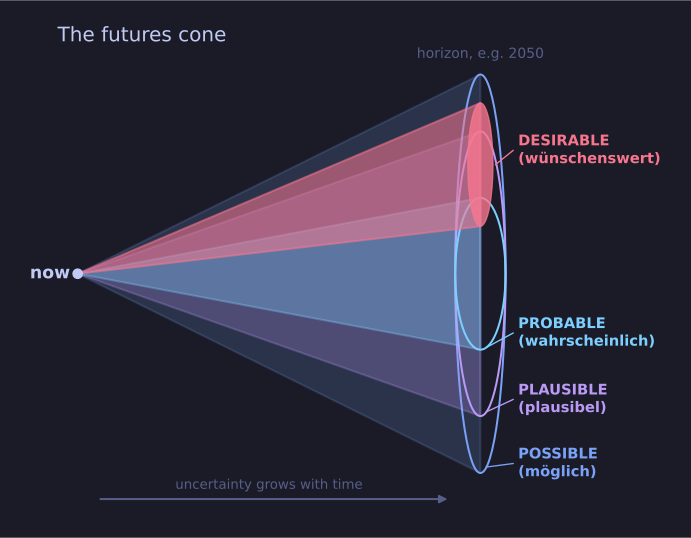
* Possible, plausible and probable futures nest; the desirable ones cut across *
| Class | German | Meaning | Based on |
|---|---|---|---|
| Possible | möglich | Might happen, even if it needs knowledge or conditions we don't have yet. | Imagination |
| Plausible | plausibel | Could happen given what we know today about how the world works. | Current understanding |
| Probable | wahrscheinlich | Likely to happen if current trends continue. | Trends, forecasts |
| Desirable | wünschenswert | What we want to happen. | Values, a normative judgement |
The cone widens with time because uncertainty grows the further ahead we look. Its key insight: the desirable zone is not the same as the probable one. Forecasting only studies the probable core. Futures work deliberately explores the wider space and asks how to steer towards what is desirable. The idea goes back to Hancock & Bezold (1994) and was popularised by the futurist Joseph Voros.
Go deeper:
 Joseph Voros: The Futures Cone, use and history — the full taxonomy (incl. "preposterous" and "projected") and where the cone comes from.
 Wikipedia: Futures studies — the field the cone comes from.