What is the difference between rationalisation and rationing in health care, and which comes first?
Rationalisation means using up efficiency reserves so that the same level of care costs less; rationing means withholding care that would be beneficial. Rationalisation comes before rationing, and it is in principle a moral duty, because there is no right to waste.
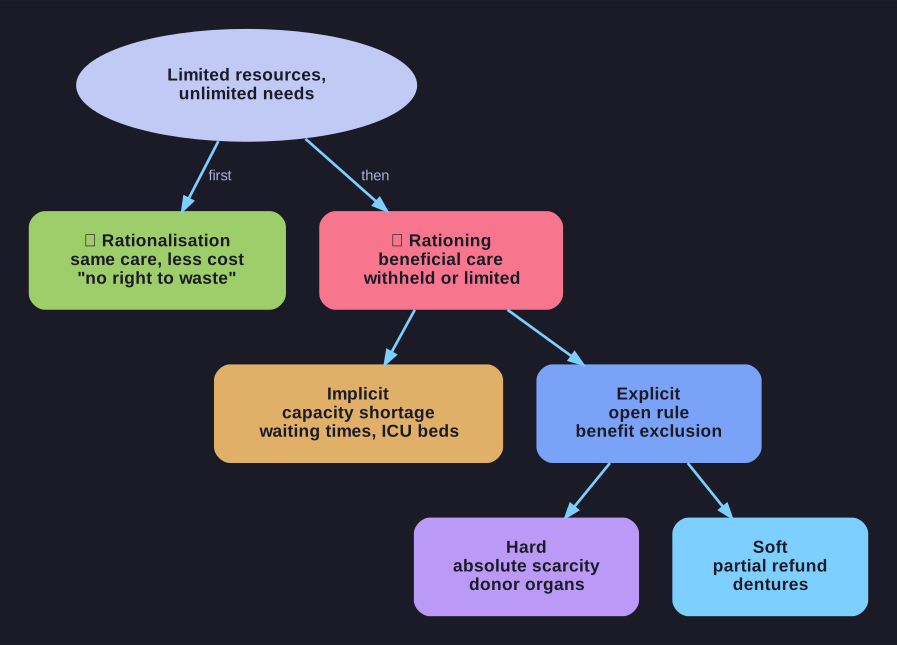
* Rationalisation keeps the level of care; rationing lowers it, implicitly or explicitly *
Rationalisation (Rationalisierung) exhausts efficiency reserves to provide a given level of care with less money. It is moral in principle: doctors who invoke their freedom of therapy against it must be told that there is no right to waste. There is broad consensus that rationalisation comes before rationing.
But two limits:
- Personal services like health care have only limited rationalisation potential; you cannot make a nurse's conversation with a frightened patient arbitrarily faster.
- The line is often blurred: merging hospitals or concentrating departments in one place is meant as rationalisation, but seen from "how fast can I reach help in an emergency?" it can be a form of rationing.
Rationing (Rationierung) withholds or limits beneficial services; its forms are on the next card.
Go deeper:
 Wikipedia: Health care rationing — explicit vs. implicit rationing across countries.