What is the difference between front-channel and back-channel transmission of an authentication confirmation?
Front channel: the IdP sends the confirmation to the subject (the browser or client app), which hands it to the RP. Back channel: the IdP gives the subject only a reference, which the subject passes to the RP; the RP then fetches the confirmation directly from the IdP within the allowed time and with the right authorisation.
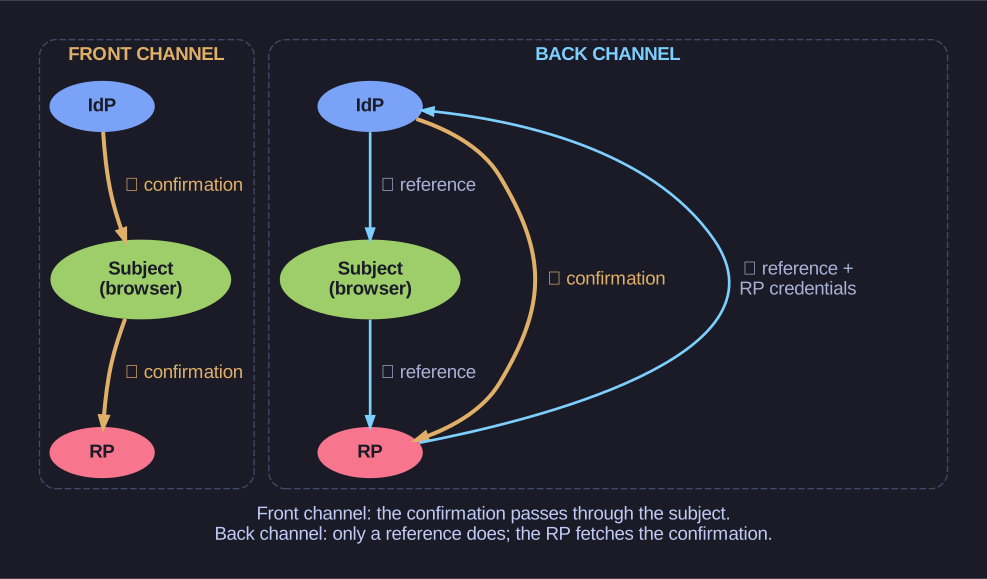
* In the back channel, the assertion itself never passes through the user's hands. *
| Front channel | Back channel | |
|---|---|---|
| Path of the confirmation | IdP to subject to RP | IdP to RP directly |
| What the subject carries | The full confirmation | Only a reference (e.g. a code in a redirect URL) |
| Exposure | Readable in the browser, logs, history, by scripts | Only the short-lived reference is exposed |
| Examples | SAML Web SSO POST binding, OpenID Connect implicit flow | SAML artifact binding, OpenID Connect authorization code flow |
The reference alone is worthless to an eavesdropper: it is valid only for a short time, can typically be redeemed once, and only by an RP that authenticates itself to the IdP. This is why VSF2 accepts a back channel instead of encrypting the assertion. Modern OAuth security guidance (RFC 9700) likewise recommends against the implicit grant, which returns tokens in the front channel.
Go deeper:
 NIST SP 800-63C-4: Back-channel presentation — the assertion reference and how the RP redeems it.
- RFC 9700: OAuth 2.0 Security Best Current Practice, implicit grant — why front-channel token delivery is discouraged.