Quiz Entry - updated: 2026.10.22
What is the decision flow when a data source changes or disappears?
Check whether the data source is still needed. If it is irrelevant, decommission it. If it is needed and a replacement exists, onboard the replacement (the integration process) and decommission the old one. If there is no replacement, inform all affected applications and find a joint solution.
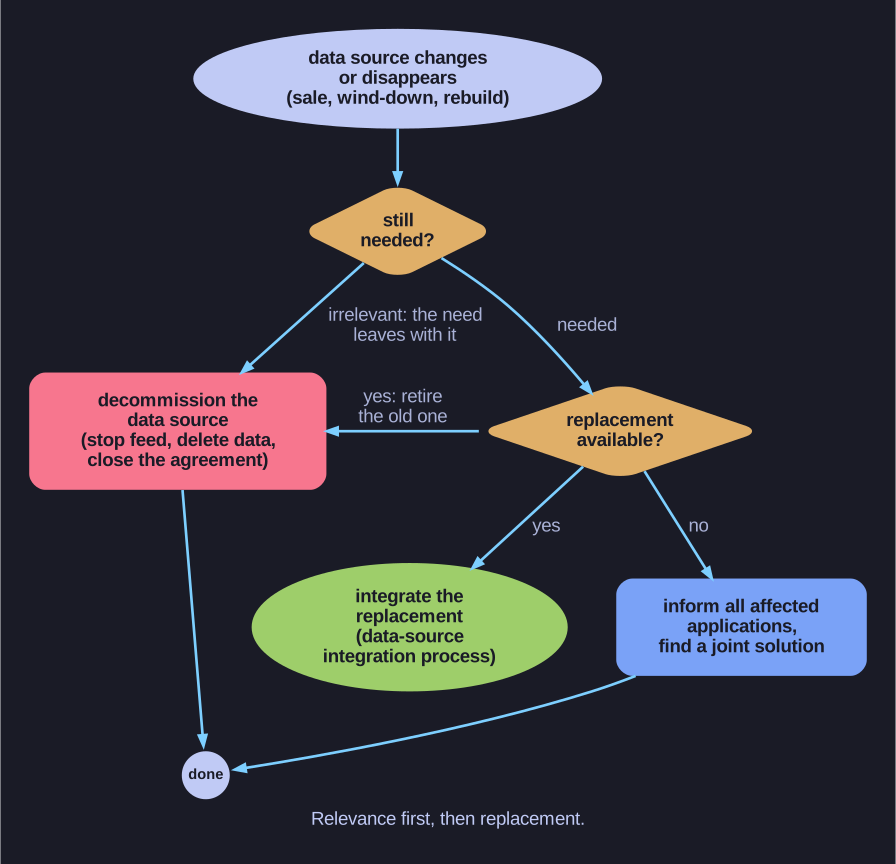
* Relevance first, then replacement: the two questions that decide a source's end of life. *
- Relevance check: is the source still needed? The key question is does the need disappear along with the source? If a division is sold, its people leave the IAM scope too, so their source becomes irrelevant and can be decommissioned.
- If the source is still needed: is there a replacement?
- Yes: the replacement is connected through the regular data-source integration process, and the old source is decommissioned.
- No: inform all affected applications and find a joint solution with them. The IAM cannot conjure up the data; the consumers have to decide together how to cope (an interim source, manual maintenance, reducing the service).
Example: the company replaces its HR system. The old one is still relevant (employees still exist), a replacement exists (the new system), so the new system is onboarded with its own data delivery agreement and connector, and the old connector is shut down.
Go deeper:
 Change management (ITSM) (Wikipedia) — assessing impact and informing stakeholders before a change, as the relevance and replacement checks do.