Quiz Entry - updated: 2026.10.22
What is the basic idea behind how an automation tool like Ansible works?
You declare the desired end state; the tool checks the current state and only changes what differs, then stops.
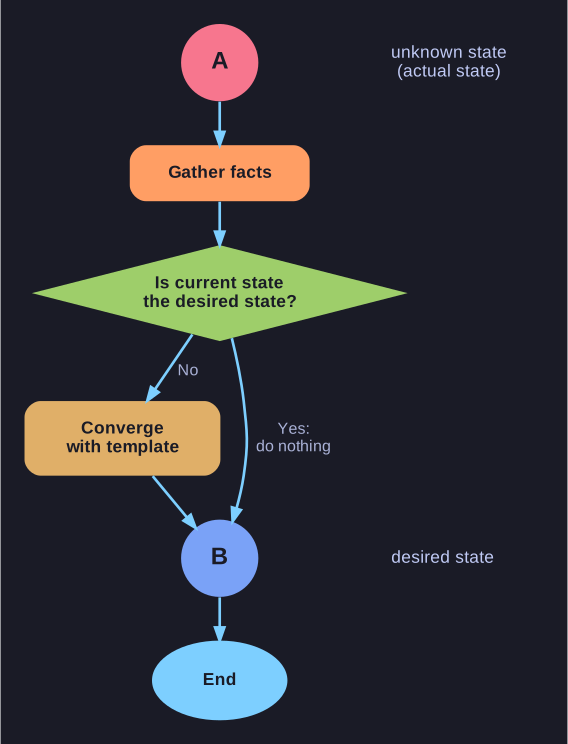
* The tool gathers facts first and only converges when the current state differs from the desired one. *
- Define the end state. For example: "a web server is installed and running."
- Gather facts. The tool looks at the system as it is now (the Ist-Zustand, actual state), which starts out unknown.
- Compare. Is the current state already the desired state?
- Yes: do nothing.
- No: converge, meaning make exactly the changes needed (for example install the web server).
- End in the desired state, and finish.
The key point is step 3. The tool does not blindly run a list of commands. It decides whether a change is needed, which is what makes it safe to run again and again.
Go deeper:
 Ansible playbooks (official docs) — how tasks express desired state, what "changed" vs "ok" means, and why runs are safe to repeat.
- What is Infrastructure as Code? (Red Hat) — contrasts the declarative "describe the end state" approach with imperative step lists.
- Ansible (software) (Wikipedia) — overview of the architecture and design goals.