What is an automation execution environment, and what problem does it solve?
A container image with ansible-core, the needed content collections and all their dependencies. Playbooks run inside it, so they behave the same on every machine.
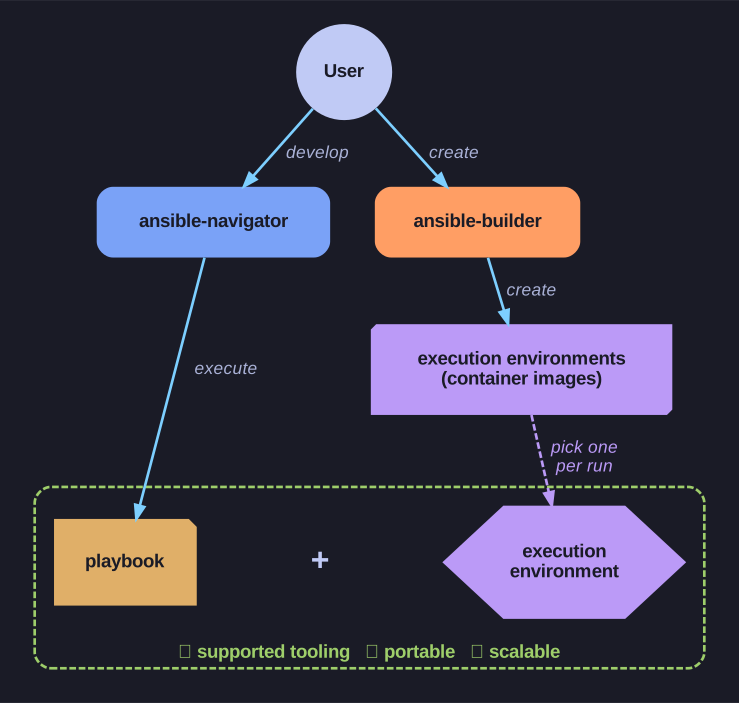
* ansible-builder builds the images; ansible-navigator runs the playbook inside one of them. *
Without execution environments, a playbook depends on what is installed on the control node: the Ansible version, Python libraries, collections. Two admins' laptops can produce different results, and the controller server differs again.
An execution environment (EE) packs all of that into one container image:
ansible-builderis used to create EEs (choose base image, collections, Python and system packages).ansible-navigatoris used to develop and execute playbooks inside a chosen EE.- The same EE can be handed to the automation controller.
The result: supported tooling, portable (same image everywhere) and scalable (containers can run anywhere). This is what "separating the control node from the execution environment through containerisation" means.
Go deeper:
 Getting started with Execution Environments (official docs) — hands-on tutorial building and running a containerised EE.
- Introduction to Ansible Builder (official docs) — how EE images are defined (Python, ansible-core, collections, system packages) and built.
 Ansible Navigator documentation — the text UI that runs playbooks inside a chosen EE.