Quiz Entry - updated: 2026.10.22
What happens step by step in phase 1 of Kerberos, the exchange between client and Authentication Server?
The client sends an AS-REQ (user ID, the TGS as requested service, desired lifetime); the AS looks the user up, creates a TGS session key, encrypts it with the client's secret key, packs it also into a TGT encrypted with the KDC key, and sends both; the client decrypts the session key with its password-derived key and caches both.
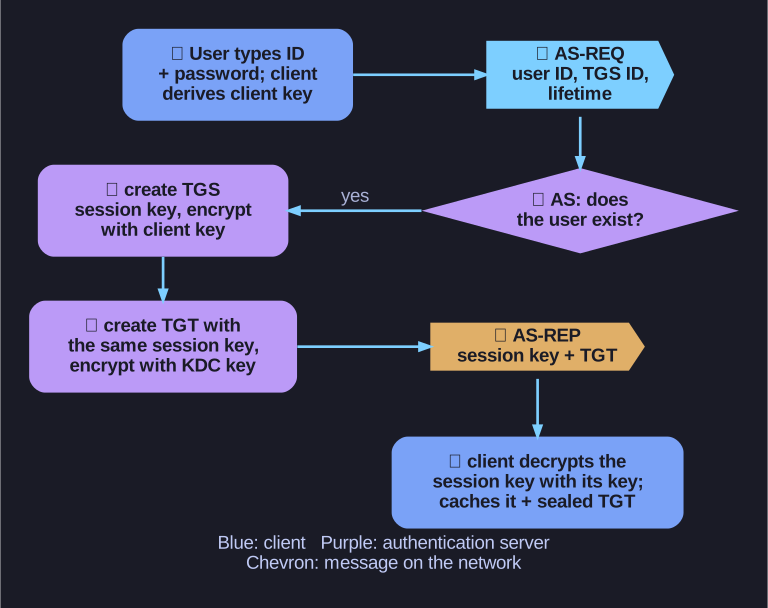
* Phase 1: the password only ever turns into a key on the client; the AS reply is useless without it. *
- The user enters user ID and password on the laptop; the client derives the client secret key from the password.
- The client sends the AS-REQ (Authentication Service Request): user ID and optionally network addresses, the requested service (the TGS), the requested TGT lifetime.
- The AS checks the user against its database.
- It creates a TGS session key and encrypts it with the client secret key from its database.
- It creates the TGT, puts the same TGS session key into it, and encrypts the TGT with the KDC key.
- The client receives both (AS-REP). It decrypts the TGS session key with its client secret key and stores it in the credential cache; the TGT it stores still encrypted.
After this phase the client holds a TGS session key in clear and a TGT it cannot read, and the password can be forgotten.
Go deeper:
 RFC 4120, Section 3.1: The Authentication Service exchange — AS-REQ and AS-REP and every check the KDC makes.
- Microsoft Learn: Kerberos authentication overview — how Windows uses the same exchange at domain logon.