What exactly does a phone sweep during the RF Power Scan, and what is an ARFCN?
GSM divides its frequency bands into numbered narrow-band channels called ARFCNs (Absolute Radio Frequency Channel Numbers); the RF Power Scan tunes to every ARFCN in turn and measures how much energy it receives there (RxLev/RSSI).
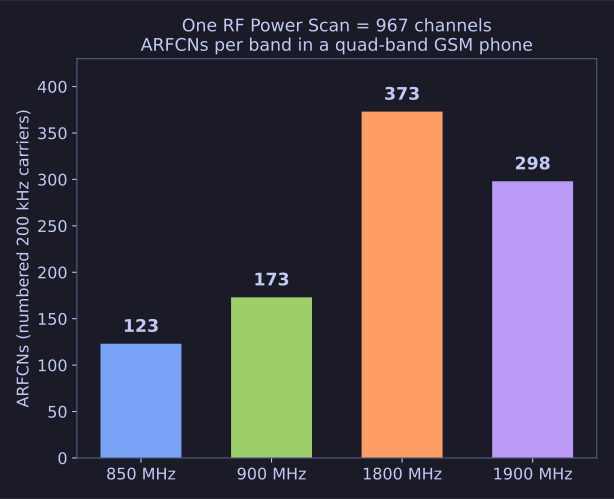
* The 967 numbered channels one quad-band RF Power Scan sweeps. *
The channel grid: GSM is an FDMA system at heart — the spectrum is pre-divided into many narrow carriers (200 kHz each), and every carrier has a standardized number, its ARFCN. "Channel 42" therefore means exactly the same frequency to every phone and every base station, and one ARFCN names a duplex pair: the downlink frequency and its fixed uplink partner together.
How many channels a phone must check (the counts for a quad-band GSM phone):
| Band | ARFCNs |
|---|---|
| 850 MHz | 123 |
| 900 MHz | 173 |
| 1800 MHz | 373 |
| 1900 MHz | 298 |
| Total | 967 |
What the scan actually produces: a table of "ARFCN → received energy" (RxLev/RSSI) over all ~967 channels — nothing more. At this point the phone has no idea who is transmitting; it only knows which channels are worth a closer look. That is why the scan is quick: measuring energy needs no decoding, so sweeping under a thousand channels takes seconds — conceptually like a WLAN scan, just over ~967 numbered channels instead of a handful.
Tip: ARFCN is the mobile cousin of a Wi-Fi channel number — an agreed shorthand for a frequency, so that lists ("scan results", "cell allocation", "neighbour cells") can name frequencies compactly.
Go deeper:
 Absolute radio-frequency channel number (Wikipedia) — the full number↔frequency mapping tables per band, including the exact formulas that turn "channel 42" into an uplink/downlink frequency pair.