What does the broken windows theory say, and how does predictive policing build on it?
Visible signs of disorder that nobody fixes signal that nobody cares, which lowers the threshold for more crime. Predictive policing finds these disorder hot spots with data, so the police can be present there before crime spreads.
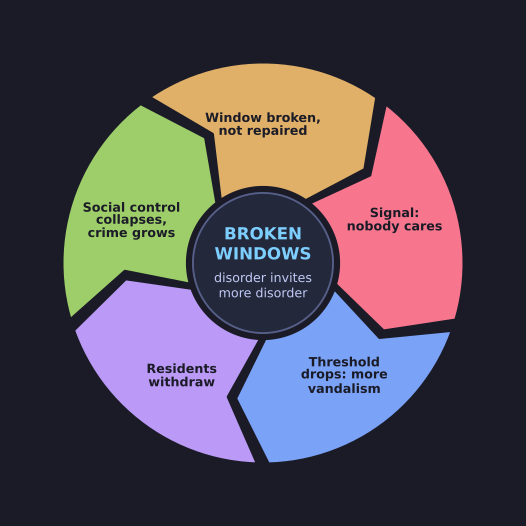
* The vicious circle of decay: each stage makes the next more likely *
The theory describes a vicious circle of decay:
- A small damage stays unrepaired: a window is broken and not fixed.
- Signal of indifference: it looks as if nobody cares about the building or the area and rules are not enforced.
- The threshold drops: more windows are broken, rubbish is dumped, vandalism grows.
- Residents withdraw: law-abiding people feel unsafe, avoid public space or move away.
- Crime gets worse: with informal social control gone, criminal groups take over.
The strategy that follows is proactive presence: the police act early in disordered places to raise the threshold for crime and send the signal "we care about this place". Predictive policing supplies the tool: it steers limited resources to these hot spots as precisely as possible in space and time. In short, broken windows gave the criminological reason to tackle small offences and disorder, and predictive policing gives the technological means to target that work.
Go deeper:
 Wikipedia: Broken windows theory — origins (Wilson and Kelling, 1982), policing use and criticism.