What does "multisystem thinking" (Multisystemdenken) add to the basic idea of a system?
That no system stands alone: every element belongs to several systems at once, and systems nest and overlap — so you always have to ask which system you are currently looking at.
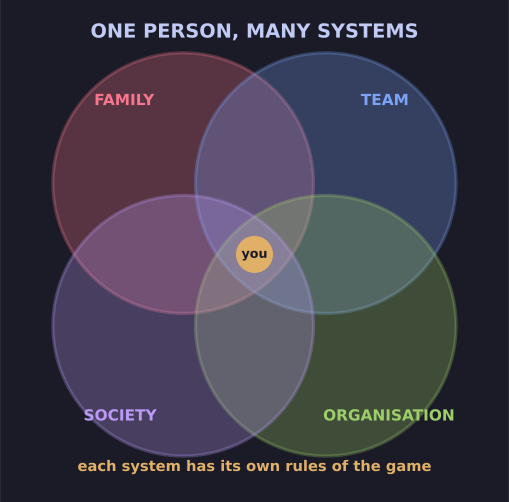
* One person, many systems: the same element sits in several webs at once, each with its own rules of the game. *
A single person is simultaneously part of a family, a team, an organisation, a profession and a society; an organ is part of a body that is part of an ecosystem. Each of those systems has its own interconnections and its own "rules of the game," and the same element or behaviour can mean something different in each. Taking this seriously changes how you analyse:
- Interventions ripple across systems — change something in one web (a new job) and the others move too (the family's routines, the old team's workload).
- Conflicts are often colliding system logics — what one system rewards (the team's overtime culture), another resents (the family's evening together); neither side is simply "wrong," they follow different rules.
- The systemic question gains a dimension — not just "what system is this part of?" but "which of its many systems is in play right now, and whose logic am I watching?"
Tip: Before judging a behaviour, ask which system it's a sensible move in — odd moves usually make sense in one of the other systems the person belongs to.
Go deeper:
 Wikipedia — Ecological systems theory — Bronfenbrenner's classic model of one person developing inside several nested systems at once.