Quiz Entry - updated: 2026.10.22
What does each of the four principles of Beauchamp and Childress demand?
- Respect for autonomy: no coercion or manipulation, and actively enable the patient's choice; in practice: informed consent.
- Non-maleficence: do not harm the patient (a duty to refrain).
- Beneficence: prevent and remove harm and actively promote the patient's well-being (a duty to act).
- Justice: fair distribution of benefits and burdens, equal access, and above all care according to need.
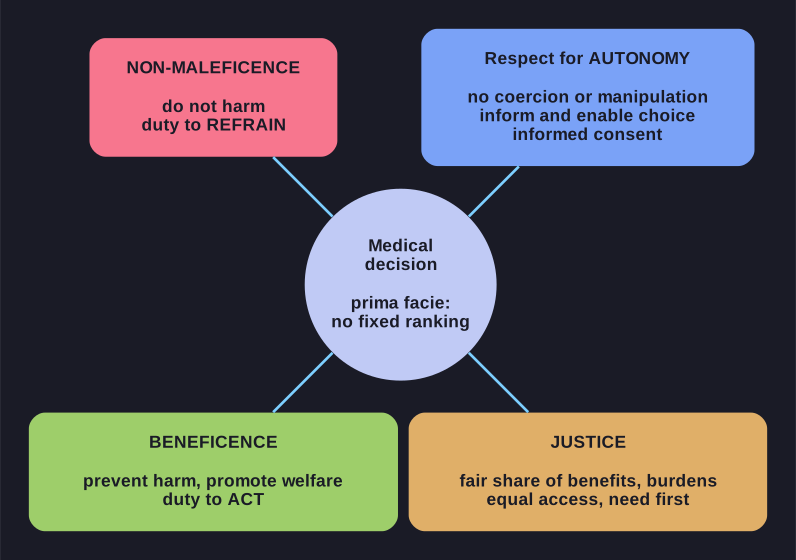
* Four prima facie principles, none ranked above the others *
- Respect for autonomy. Negative freedom: freedom from coercion or manipulative influence. Positive freedom: the doctor enables the patient's choice by informing them. In practice: informed consent before every medical measure, taking the patient's values, wishes and interests into account.
- Non-maleficence (Nichtschaden): the prohibition on harming the patient, a duty to refrain (Unterlassungsgebot). Especially important in therapy because hardly any treatment is free of side effects (e.g. chemotherapy), so benefit, harm and risk must be analysed and weighed every time.
- Beneficence (Wohltun): the counterpart. A duty to act (Handlungsgebot): prevent and remove harm, and actively promote the patient's well-being. Again requires weighing benefit, harm and risk.
- Justice: fair distribution of benefits and burdens in health care, e.g. income-dependent financing. Formally, the equality principle (equal access to services). Most important is the need principle: take the measure that meets the patient's fundamental, existential needs, because not meeting them would necessarily cause serious harm.
Tip: non-maleficence and beneficence look alike but differ in kind: one says don't (refrain from harming), the other says do (act to help).
Go deeper:
 Wikipedia: Beneficence (ethics) — the duty to act for the patient's good.
- Wikipedia: Primum non nocere — the history of "first, do no harm".