Quiz Entry - updated: 2026.10.22
What does "agentless" mean for Ansible, and how does a task actually run on a managed host?
No Ansible software runs permanently on managed hosts. The control node connects over SSH (or WinRM), copies a small module over, runs it, and deletes it when done.
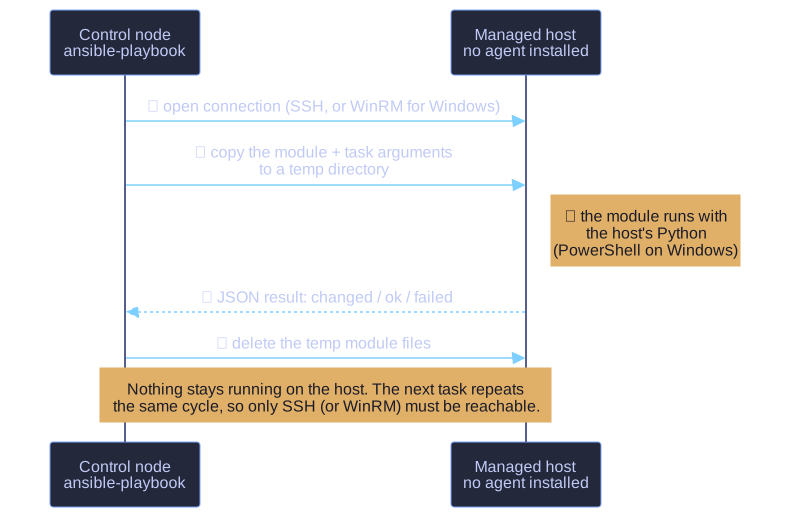
* Each task pushes a module, runs it, collects the result and cleans up, so nothing stays running on the host. *
Step by step, for each task:
- The control node opens a connection to the host, by default over SSH (Linux/UNIX) or WinRM (Windows).
- It transfers a small program, an Ansible module, together with the task's arguments.
- The module runs on the host and puts the system into the requested state (for example "package nginx is installed").
- The module reports back what it did (changed / unchanged / failed).
- When Ansible is done, the pushed modules are removed.
Contrast this with agent-based tools like Puppet or Chef, where a daemon runs permanently on every server and must be installed, updated and secured.
Go deeper:
 Ansible module architecture (official developer docs) — under the hood: how AnsiballZ packages a module, ships it to a temp dir on the host and executes it.
- How Ansible Works (Ansible Collaborative / Red Hat) — modules are copied over, run, and removed when finished.
- Connection methods and details (official docs) — native OpenSSH, key-based auth and the non-SSH connection options.