What does a system view (Systemdarstellung) of the business-customer LCP show, and what does the IdP sync job decide?
It shows which systems and components take part and which function calls which: sales use CRM functions, the CRM calls an IdP sync job, and the job checks which action is needed, then updates an existing user or creates a new one with an initial password and writes the changes into the IdP.
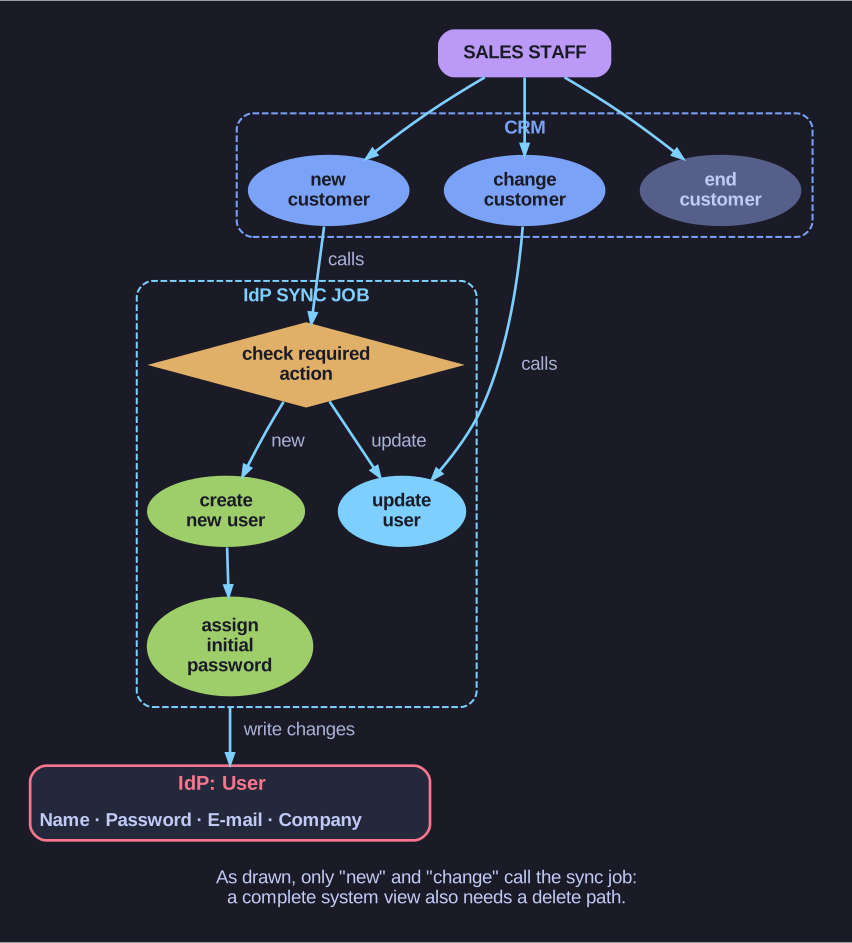
* The system view answers "which component does what", not "in which order under which condition". *
The parts:
- CRM with three functions for sales: new customer, change customer, end customer.
- IdP sync job, called by the CRM: check required action decides between update (the user exists: update it) and new (create the user, then assign an initial password).
- IdP with the target object User (name, password, e-mail, company), into which the job writes its changes.
This view suits architects and administrators: it shows interfaces, which component owns which logic, and where a job must be scheduled and monitored.
It also illustrates why you cross-check representations. As drawn, only new customer and change customer call the sync job, and the job knows only "update" and "new". The text and the flowchart, however, propagate deletions to the IdP. A complete system view needs a delete path too (the end-customer function calling a delete action in the job). Differences like this between two views of the same process are a cheap way to find gaps before they reach production.
Go deeper:
 Use case diagram (Wikipedia) — the notation behind actors and system functions drawn as ovals inside system boundaries.
- Data synchronization (Wikipedia) — keeping two data stores consistent, the job the IdP sync job performs.