What does a sequence diagram add when the business-customer LCP and the account LCP are modelled together?
It draws the objects (CRM.Customer, IdP.User) and actors as lifelines and the messages between them in time order, so it shows how the two LCPs meet: the sync either updates a user the customer already created by registering, or creates a new one.
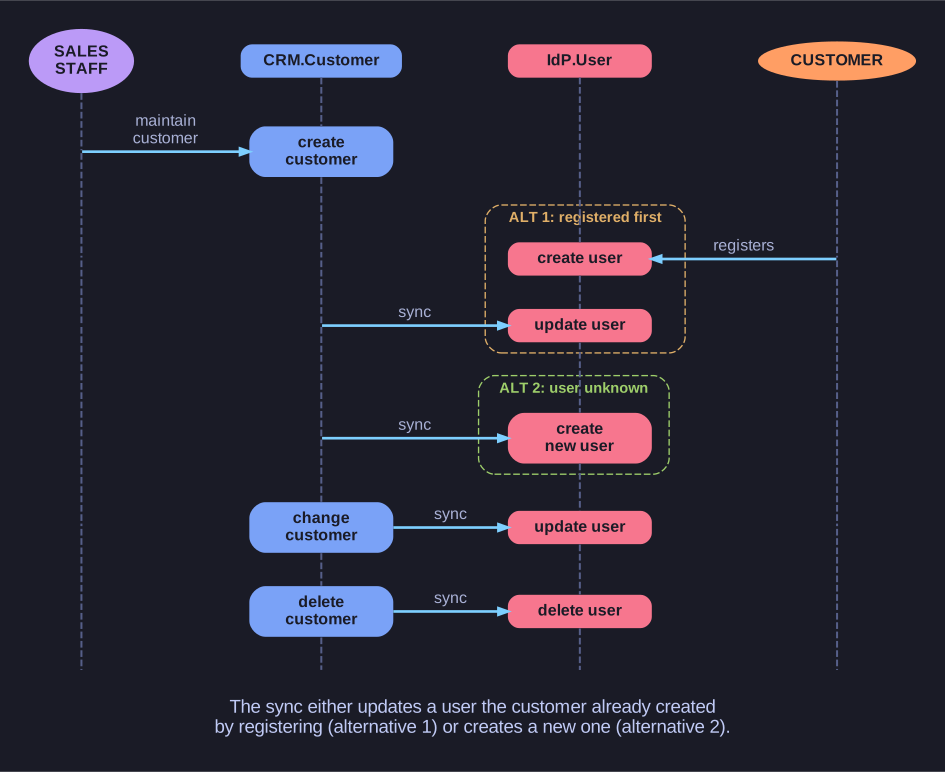
* Two alternatives for the same CRM event, depending on what the customer did before. *
Reading it top to bottom:
- Sales maintain the customer: create customer on the CRM.Customer lifeline.
- Alternative 1: the customer had already registered in the self-service, so an IdP user exists; the CRM's sync message updates that user (adds the company).
- Alternative 2: no user exists yet; the sync creates a new user.
- Change customer and delete customer follow the same pattern and lead to update user and delete user.
The value is that it puts two processes on one timeline. The customer's registration belongs to the account LCP and the sync belongs to the business-customer LCP; only a diagram with both lifelines shows that the order of these events changes what the sync must do.
Such a sketch is often not formally correct UML, and that is acceptable if the audience understands it. In strict UML the two alternatives would be an alt combined fragment with guard conditions such as [user exists] and [else].
Go deeper:
 Sequence diagram (Wikipedia) — lifelines, messages and combined fragments such as alternatives.