What do historical pictures of the future, such as the French En l'an 2000 cards or the 1950s "kitchen of the future", reveal?
They show impressive gadgets inside an unchanged society: the maid still scrubs, the teacher still rules the classroom, the housewife still cooks. How we imagine the future says more about the present than about the future.
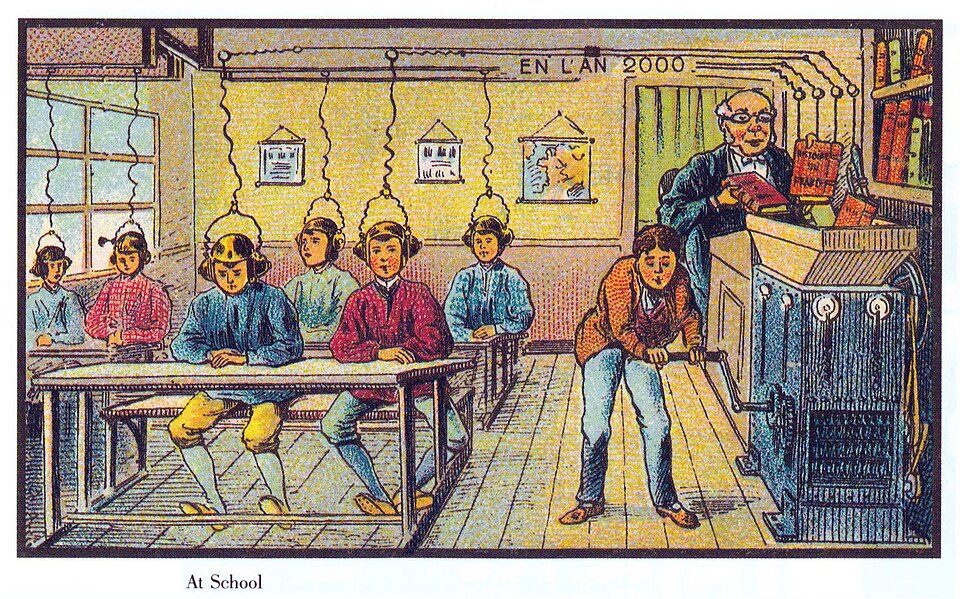
* "At School", from the En l'an 2000 series (France, c. 1900), public domain, via Wikimedia Commons *
Around 1900, French illustrators (Jean-Marc Côté and others) drew a series of cards imagining life in the year 2000: machines that pour books into pupils' heads, a remote-controlled floor scrubber operated by a maid, farming by machine. The 1950s "kitchen of the future" does the same: new appliances, same housewife.
What is striking is what does not change: class relations, servants, gender roles, the shape of school. The technology is extrapolated, while society is copied from the time the picture was made. The same happens today: asked to draw "the future of Switzerland", an image generator produces glass towers, drones and trains in an Alpine valley, a product of today's visual clichés.
The lesson: a picture of the future is a mirror of its own present, with its hopes, fears and blind spots. Reading futures critically means asking what they quietly assume will stay the same.
Go deeper:
 Public Domain Review: A 19th-Century Vision of the Year 2000 — the full card series with commentary.
- Wikipedia: En L'An 2000 — the history of the cards and how Asimov rediscovered them.
- Wikipedia: Retrofuturism — past visions of the future as a subject in their own right.