What capabilities does a dedicated digital ISMS/GRC platform typically bundle, and why do organizations use one instead of documents and spreadsheets?
A digital ISMS platform bundles policy management, an asset register, risk management, a multi-compliance control library, assessments, templates, mitigation tracking and dashboards — one integrated system instead of scattered documents.
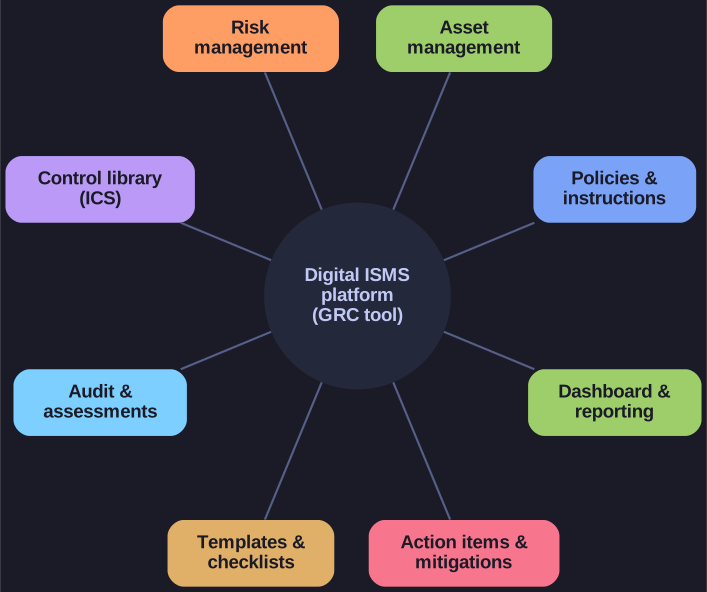
* The capability wheel of a digital ISMS platform: policies, assets, risks, controls, audits, templates, mitigations and reporting — all linked in one hub. *
Commercial examples include the GRC Toolbox and 360inControl® (a Swiss "digital & comprehensive ISMS" by CISS Ltd). The typical capability wheel:
- Policies & instructions — simplified policy management in one place
- Asset management — the centralized asset register the ISMS core domains revolve around
- Risk management — integrated identification and assessment of IT risks
- Control library (ICS — Internal Control System) — multi-compliance capable, so one control maps to many standards at once
- Audit & assessments — comprehensive assessment capabilities with individual and automated templates & checklists
- Action items & mitigations — fully integrated tracking of corrective measures
- Dashboard & reporting — maturity and compliance status at a glance
The reason to use one: an ISMS is a continuous management process, and a platform keeps its artifacts (assets, risks, controls, exceptions, findings) linked and queryable, where standalone documents drift apart. The ISMS itself is still the concept and process — the platform is just where it is recorded and reported.
Go deeper:
 360inControl — integriertes GRC-Ökosystem — Ein reales Beispiel: Schweizer Plattform mit Policy-, Asset-, Risiko- und Kontroll-Management plus Assessments und Dashboards.