Quiz Entry - updated: 2026.10.22
What are the steps of the scenario technique (Szenario-Technik), and what does the method achieve?
Starting situation (analytical, descriptive) → projections (speculative glimpses of the future) → future scenarios → backcasting. It combines quantitative and qualitative knowledge, explores possible developments and the paths to them, and so strengthens our ability to act in uncertain times.
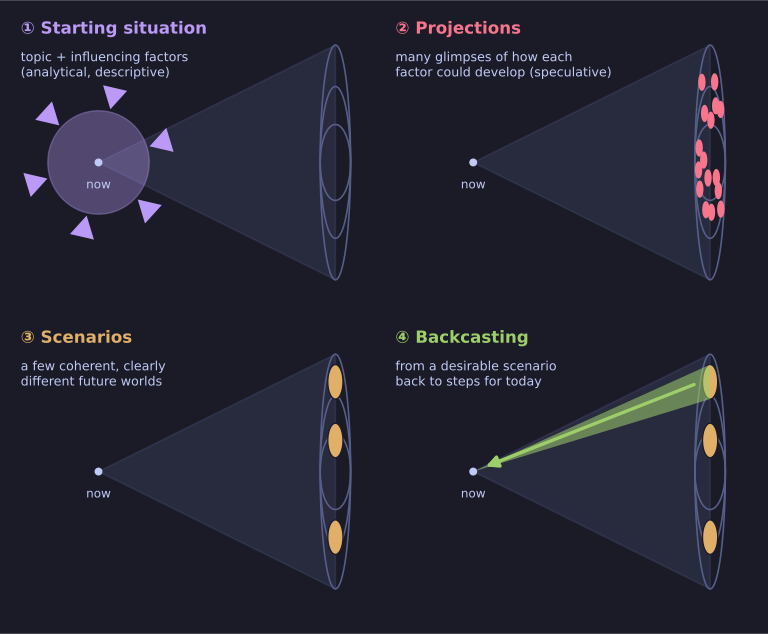
* From today's situation to scenarios, and back again to today *
The steps move from analysis to speculation and back:
- Starting situation (Ausgangslage): define the topic and its influencing factors today. This part is analytical and descriptive.
- Projections (Projektionen, Ausschnitte aus der Zukunft): imagine how each factor could develop. This is where speculation begins.
- Future scenarios (Zukunftsszenarien): bundle projections into a few coherent pictures of the future.
- Backcasting: work back from a desirable scenario to what must happen today.
What the method achieves:
- it connects quantitative and qualitative sources of knowledge (statistics and trends and expert judgement, values, stories);
- it lets us explore future developments mentally and learn the paths that lead there;
- in doing so it helps us understand the present better;
- it strengthens our agency in uncertain times.
Go deeper:
 Wikipedia: Scenario planning — origins at RAND and Shell, and how scenarios are built.
- Wikipedia (de): Szenariotechnik — the German method with the scenario funnel and its phases.