On which three levels are health-care decisions made, and why does it matter to keep them apart?
The macro level (society: health policy), the meso level (institutions such as hospitals and care homes) and the micro level (treatment decisions at the bedside). Each involves different people, criteria and questions, so mixing them up causes misunderstandings, e.g. in rationing debates.
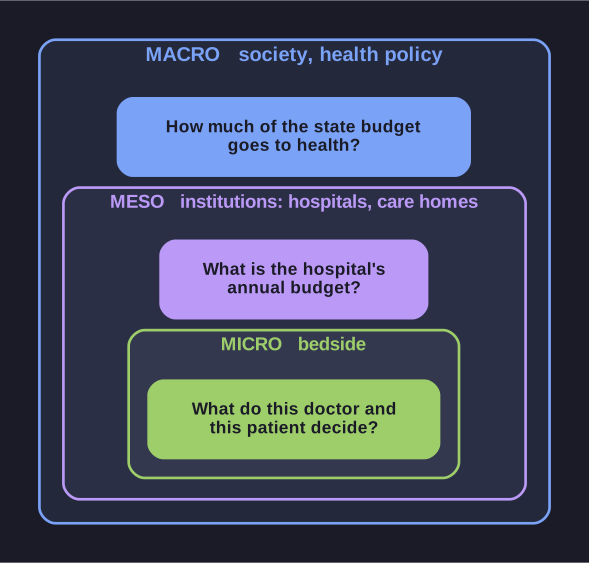
* Three levels, three kinds of question *
| Level | Where | Typical question |
|---|---|---|
| Macro | society, health policy | economic: how much of the state budget goes to health? |
| Meso | design of institutions (hospitals, care homes) | business: what is the annual budget of a university hospital? |
| Micro | treatment at the bedside | interpersonal: what do this doctor and this patient decide? |
Why it matters: "rationing" means something different on each level. Setting the benefits catalogue (macro) is a political decision; a hospital closing a ward (meso) is a management decision; a doctor not offering a treatment (micro) affects one person directly. Arguments that work on one level, such as cost-effectiveness for a national budget, can be inappropriate on another, such as at a specific patient's bedside.
Go deeper:
 Wikipedia: Health care rationing — rationing decisions at system and bedside level.