Quiz Entry - updated: 2026.10.22
In which areas does IAM deliver benefit? Name the main fields.
Access management (access protection), practical reasons (SSO, lower cost, fewer accounts), organisational data for applications, compliance, and three fields reaching beyond the company: IAM as digital enabler and passive use (tracking, scoring), both new, and digital services for citizens.
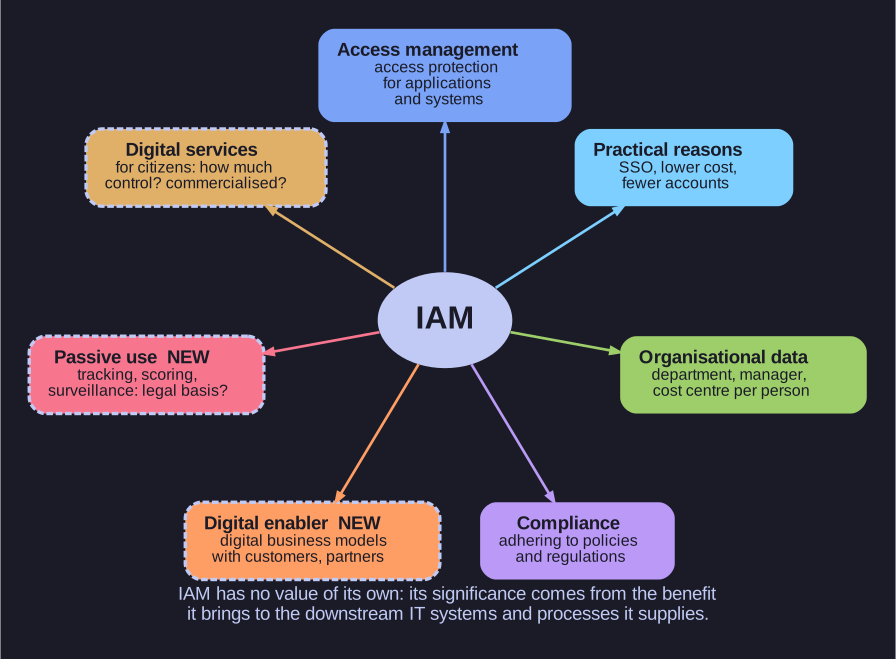
* The seven fields where IAM creates value; the dashed ones on the left reach beyond the company and raise ethical questions, two of them are new. *
| Field | What IAM contributes |
|---|---|
| Access management | Access protection for IT applications and systems, on premises and in the cloud: the classic core. |
| Practical reasons | Comfort and usability (single sign-on), cost savings through central administration, fewer accounts per person. |
| Organisational data | Applications need to know a person's department, cost centre or manager; IAM delivers this "org data" with the identity. |
| Compliance | Demonstrable adherence to policies and regulations: who had which access, approved by whom. |
| Digital enabler (new) | Makes digital business models with customers and partners possible in the first place. |
| Passive use (new) | Tracking, behaviour analysis, scoring, surveillance; raises the question of a legal basis. |
| Digital services for citizens | Identity for e-government at municipal, cantonal and state level; raises questions of control and commercialisation. |
The first four are the traditional internal benefits; the last three reach beyond the company and are where the ethical and legal questions start.
Go deeper:
 Identity and access management (Wikipedia) — functions of IAM from access control to compliance and customer identity.