In the standard SAML Web SSO flow with bearer assertions, where can an attacker steal the assertion?
At the user agent, where cross-site scripting can read the assertion as it passes through the browser, and on the way from the browser to the service provider, where a man-in-the-middle can capture it; because it is a bearer assertion, either attacker can replay it.
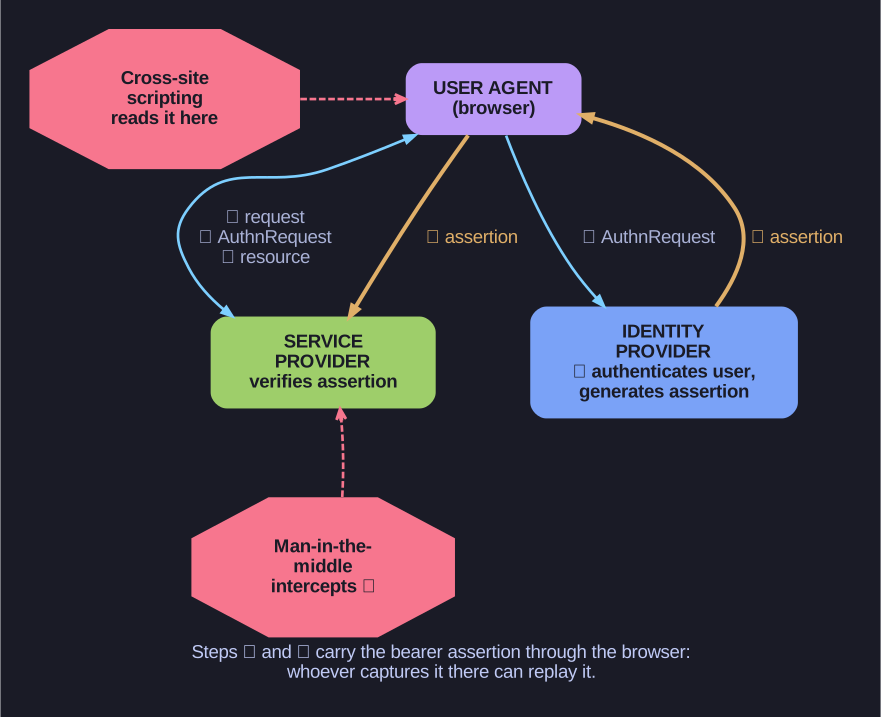
* The assertion travels through the browser, which is exactly where it is most exposed. *
The flow, step by step:
- The user's browser (user agent) requests a protected resource from the service provider (SP). The SP has no security context; the user is not identified.
- The SP answers with an
<AuthnRequest>, which the browser - forwards to the identity provider (IdP).
- The user authenticates at the IdP, which generates an assertion.
- The IdP returns an
<AuthnResponse>with the assertion to the browser, - which posts it to the SP. The SP verifies the assertion
- and grants access (or returns an error).
The weak spots are steps 5 and 6, where the assertion sits in the browser and travels to the SP. Cross-site scripting (malicious JavaScript running in the page) can read it from the browser, and a man-in-the-middle on the browser-to-SP connection can intercept it. Since the SP accepts a bearer assertion from anyone, the stolen copy works for the attacker.
Go deeper:
 Security Assertion Markup Language: profiles (Wikipedia) — the Web Browser SSO profile and its bindings.
- Cross-site scripting (Wikipedia) — how injected scripts read data in the victim's browser.