In the dementia-and-pneumonia case, suppose the patient's earlier notes suggest she would refuse treatment, yet she seems fairly content. How is the resulting conflict weighed?
The conflict is respect for her (presumed) will, which says withhold antibiotics, against the duty of care, which says treat. One defensible weighing gives autonomy priority because the dementia is advanced and incurable and the evidence of her will is reliable; a different preference rule ("preserve life whenever possible") would justify treating. Either way the reasons must be made transparent.
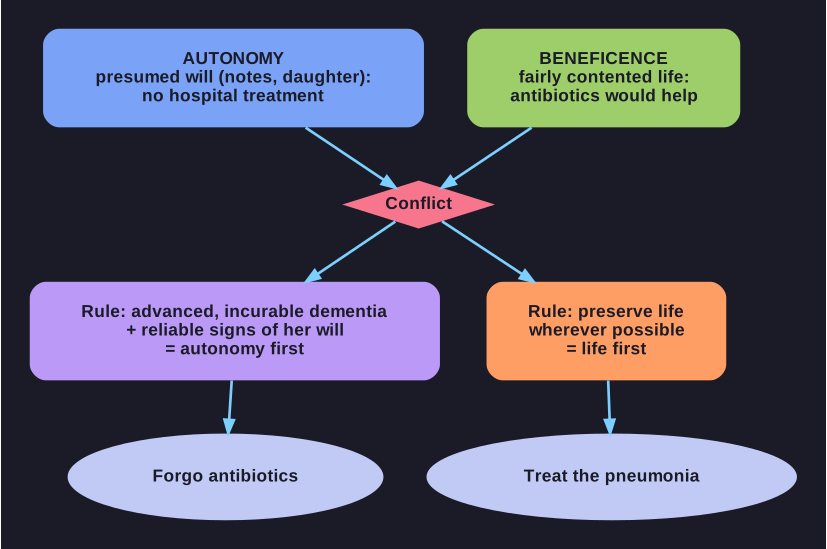
* The principles name the conflict; the weighting rule decides it *
The situation: not only the daughter but also the patient's earlier written notes suggest that withholding treatment most probably matches her presumed will. But she hardly seems to suffer and leads a limited but fairly contented life, so beneficence speaks for antibiotics.
The conflict, named precisely: respecting her self-determination requires forgoing the antibiotics; the doctor's duty of care requires the life-saving therapy.
Two possible weightings:
- Autonomy first: given far-advanced dementia with no prospect of improvement and reliable indications of her presumed will, self-determination weighs more than the duty of care. Result: forgo treatment.
- Life first: if one holds the preference rule that human life should be preserved under all conditions where possible, one can justify treating, especially since her current will cannot be determined clearly.
Since Beauchamp and Childress set no hierarchy, the approach itself cannot settle this. What it demands is a case-related, well-reasoned weighing that others can follow.
Go deeper:
 Stanford Encyclopedia of Philosophy: Autonomy in Moral and Political Philosophy — what self-determination requires and when capacity is in doubt.