How is the business-customer LCP drawn as a flowchart, and what does each flow look like?
One flow per operation (create, change, delete), each running from a start node through activities and yes/no decisions to an end node, with the actor optionally drawn on the left and the affected system on the right of each step.
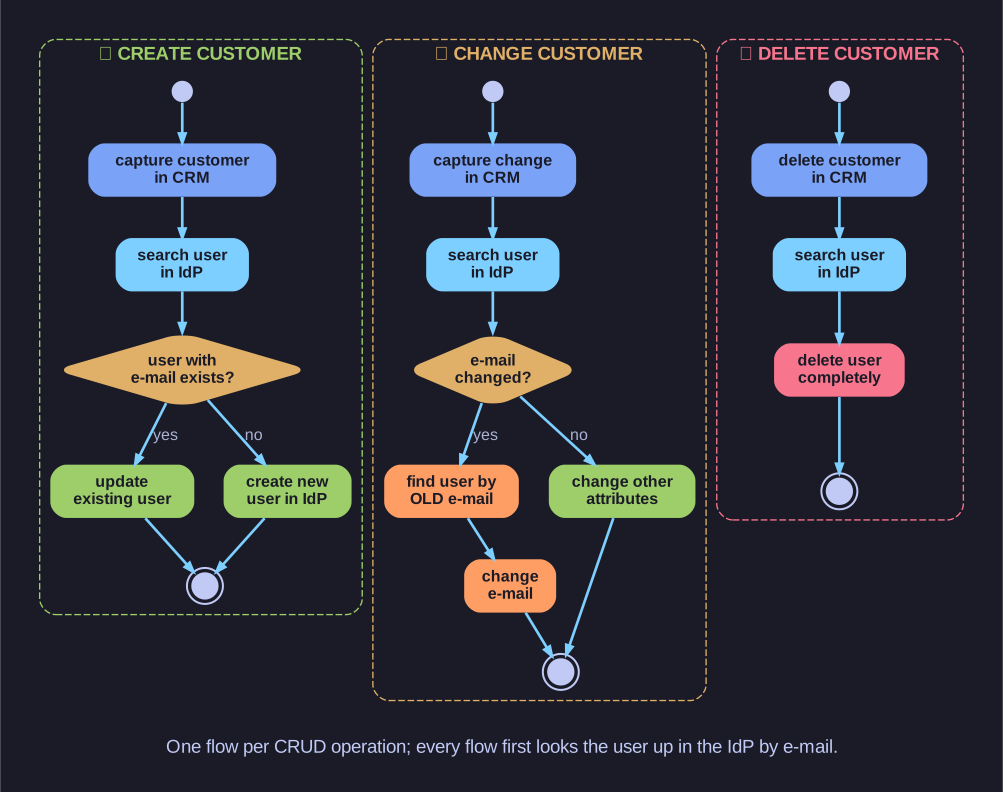
* Each decision diamond is a branch the implementation must handle and a test must cover. *
- ① Create: capture the customer in the CRM → search the user in the IdP → user with this e-mail already exists? yes: update the existing user; no: create a new user in the IdP.
- ② Change: capture the change in the CRM → search the user → e-mail changed? yes: find the user by the old e-mail, then change the e-mail; no: change the other attributes.
- ③ Delete: delete the customer in the CRM → search the user → delete the user completely.
The elements are those of a UML activity diagram: a filled start node, rounded activity boxes, diamond decisions with labelled branches, and a bull's-eye end node. Adding the actor on the left and the system (CRM, IdP) on the right of each activity turns it into a lightweight swimlane diagram, showing who does what where.
Why developers like it: every diamond is a branch in the code and a case for a test. What it does not show well is the combination of states across systems, which is why it is paired with a state table.
Go deeper:
 Activity diagram (Wikipedia) — the UML notation with start node, actions, decisions and final node.
- Swimlane (Wikipedia) — assigning each step of a flow to the actor or system responsible.