Quiz Entry - updated: 2026.10.22
How does the OAuth authorization code flow work, step by step?
The user agent gets an authorization code via the front channel after the user authenticates; the client then exchanges that code, together with its own credentials, for an access token (and optionally a refresh token) via the back channel.
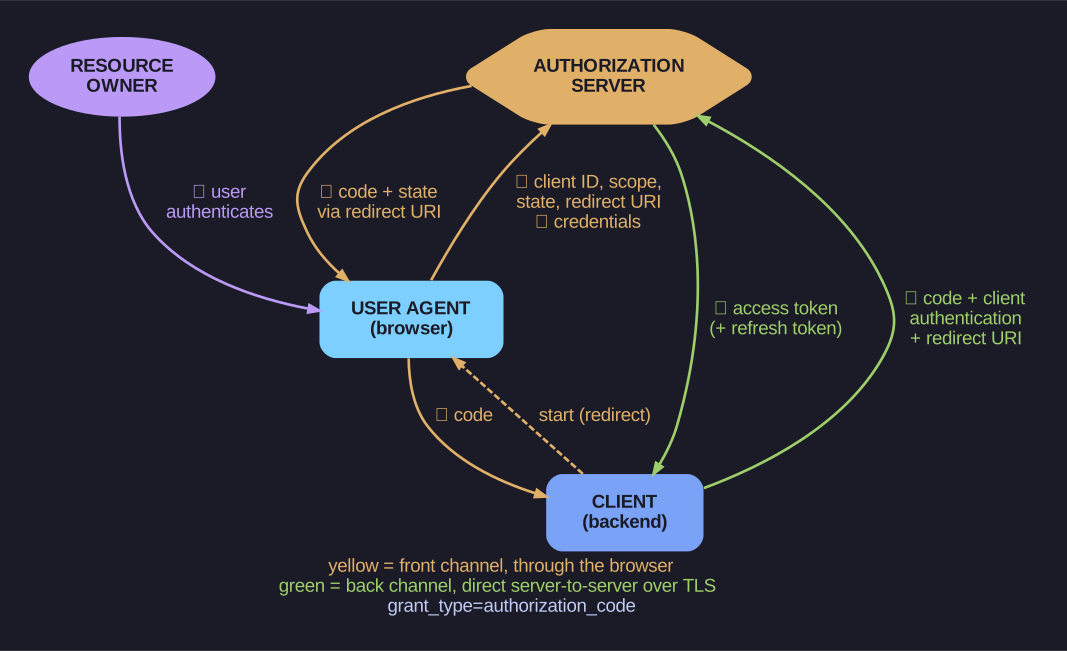
* Only the short-lived code passes through the browser; the tokens travel directly from the authorization server to the client. *
- Initial request (front channel): the client redirects the user agent (browser) to the authorization server with its client ID, the requested scope, a local
statevalue and the redirect URI. - User authenticates (front channel): the resource owner logs in at the authorization server and consents.
- Response with authorization code (front channel): the authorization server redirects the user agent back to the redirect URI with the authorization code and the unchanged
state. - Request for access token (back channel): the client sends the code, its client authentication and the redirect URI directly to the authorization server's token endpoint (
grant_type=authorization_code). - Response with access token (back channel): the server returns the access token and optionally a refresh token.
Front channel means the message travels through the browser (as a redirect URL that the user, browser extensions and history can see). Back channel means a direct, TLS-protected server-to-server HTTP request that the browser never touches.
Go deeper:
 RFC 6749, Section 4.1: Authorization Code Grant — the exact request and response parameters for each step.
- oauth.net: Authorization Code Grant — a short overview with links to the related extensions.
 OAuth 2.0 Playground (oauth.com) — walk through the authorization code flow and PKCE interactively against a real server.