How does the Institute for the Future's "Future of Immigration" map build four scenarios, and what are they for?
It crosses two core drivers, the economy (growth vs. stagnation) and attitudes to immigrants (they make us stronger vs. weaker), into a 2×2 matrix. The four resulting scenarios are conversation starters for finding leverage points, not predictions.
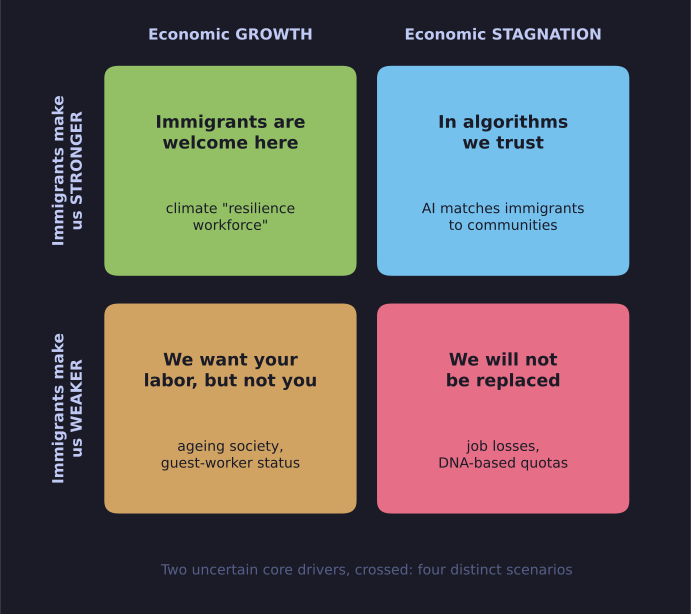
* Two uncertain drivers, four distinct worlds *
The Institute for the Future (IFTF), a Californian futures think tank, developed the map in 2019 for the USA with the James Irvine Foundation and the funders' network GCIR. The two axes were chosen because economics is the classic push-pull force of migration, and because surveys show attitudes to immigrants vary over time and between generations.
| Economic growth | Economic stagnation | |
|---|---|---|
| Immigrants make us stronger | Immigrants are welcome here: a climate-driven "resilience workforce", asylum for climate refugees | In algorithms we trust: AI matches "good immigrants" to communities that need them |
| Immigrants make us weaker | We want your labor, but not you: an ageing society uses immigrants as care workers and taxpayers but keeps them as second-class guest workers | We will not be replaced: job losses and cultural fragmentation lead to DNA-based quotas and hostility |
Other drivers (climate change, political economy, demographics, technology, media and culture) play out differently in each square. Readers are asked to develop each scenario as the prologue of a story, ask whether they would want to live in it, and list the leverage points (Stellschrauben) that could support or resist it, e.g. protecting personal DNA data or making immigration agencies transparent.
Go deeper:
 IFTF: The Future of Immigration, Four Paths — the project page with the map.
- IFTF: Ten-Year Forecast 2036 — a current example of IFTF's "flash forecasts" of high-probability changes.