Quiz Entry - updated: 2026.10.22
How does the HTTP Artifact binding work together with the Artifact Resolution Protocol, and when is it used?
Instead of the message, the browser carries only a short reference (the artifact); the receiver then fetches the real message directly from the sender over a SOAP back channel. It is used when message size matters or when the message must not pass through the browser.
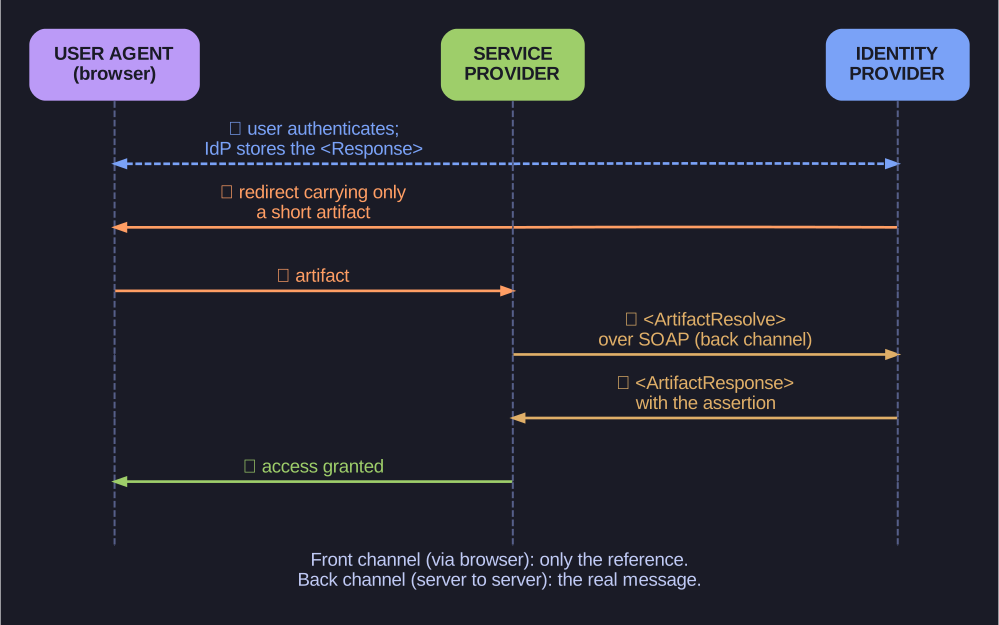
* Artifact binding: only a reference crosses the browser; the assertion travels server to server. *
- After authenticating the user, the IdP stores the
<Response>and sends the browser to the SP with a short, opaque artifact in the URL or a form. - The SP reads the artifact. Its format lets the SP identify which IdP issued it (a
SourceIDderived from the IdP's entity ID). - The SP sends an
<ArtifactResolve>over SOAP directly to the IdP (mutually authenticated). - The IdP returns an
<ArtifactResponse>containing the real message, and the artifact becomes invalid.
Why bother? The assertion never touches the browser, so a script in the page or a malicious extension cannot read it, and huge messages avoid URL and form limits. The price is a direct network connection between SP and IdP and one more round trip.
Go deeper:
 SAML 2.0: HTTP Artifact Binding (Wikipedia) — the artifact format and a full exchange.
- SAML 2.0: Artifact Resolution Protocol (Wikipedia) — the ArtifactResolve and ArtifactResponse messages.