Quiz Entry - updated: 2026.10.22
How does an authenticator generate its output value?
Output value = authentication function(secret value, [activation values], [input values]): the secret is mandatory, while activation values (such as a PIN or fingerprint) and input values (such as a random challenge) are optional.
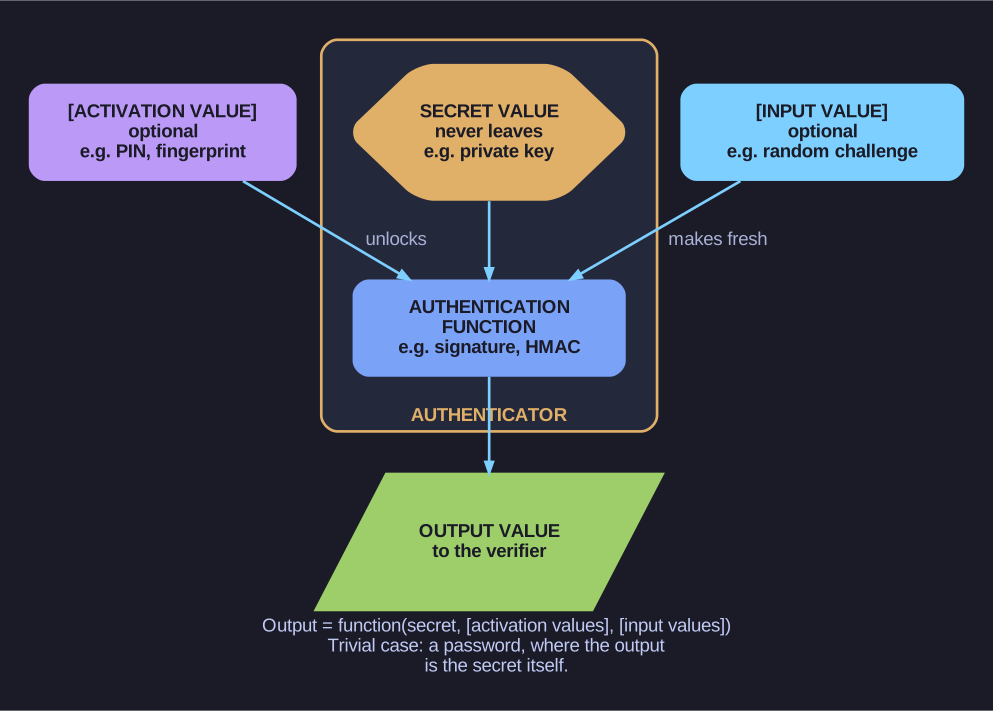
* The secret stays inside the authenticator; only the computed output leaves it. *
| Component | German term | Role | Examples |
|---|---|---|---|
| Secret value | geheimer Wert | The core of the authenticator; must never leave it | Private key, OTP seed, password |
| Activation value | Aktivierungswert | Unlocks the secret locally, adding a factor | PIN, fingerprint, face |
| Input value | Eingabewert | Makes each output unique | Random challenge, nonce, current time |
| Authentication function | Authentifizierungsfunktion | Combines the above into the output | Signature, HMAC, hash, or no function at all |
| Output value | Ausgabewert | What is sent to the verifier | Signature, 6-digit code, password |
The schema is a useful lens for comparing any two authenticators: ask what the secret is, whether something must activate it, whether a fresh input goes in, and what comes out. The answers predict most of an authenticator's strengths and weaknesses.
Go deeper:
 NIST SP 800-63-4: Authenticators — secrets, activation secrets and authenticator outputs in the NIST model.