How do you work out which life-cycle processes a system landscape needs? Apply it to the webshop with CRM, IdP and self-service.
Identify every information object that is created, changed and deleted on its own terms, give each its own LCP, and check that every attribute in every system belongs to exactly one of them; here that yields four LCPs: business customer, account, password and consent.
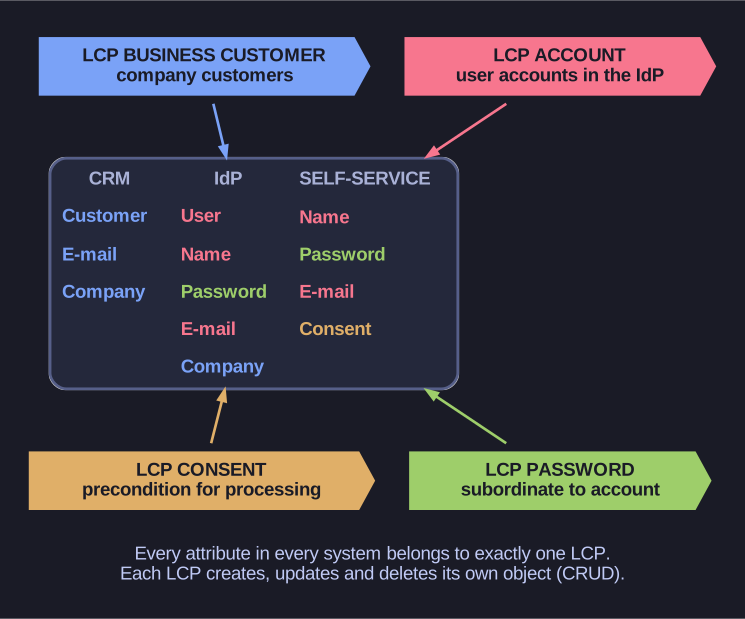
* Colour every attribute by the LCP that owns it: anything left uncoloured has no process looking after it. *
A practical method is to draw the systems with their attributes and colour each attribute by the process responsible for it:
| LCP | Manages | Attributes it owns |
|---|---|---|
| Business customer | Company customers: create, change, delete | CRM Customer with e-mail and company; the company attribute in the IdP |
| Account (Konto) | User accounts in the IdP | IdP User with name and e-mail; name and e-mail in the self-service |
| Password | User passwords in the IdP; subordinate to the account | IdP password; password field in the self-service |
| Consent (Zustimmung) | The customer's consent to data processing | Consent checkbox in the self-service |
Why split this finely? Each object has different triggers, actors and rules. The company changes when a contract changes and is maintained by sales; the password changes whenever the user wants and must never be seen by sales; consent is a legal object that can be withdrawn at any time. Lumping them into one "customer process" hides exactly those differences.
Tip: The colouring doubles as a completeness check. An attribute with no colour is created by nobody, updated by nobody and deleted by nobody, which is how stale and orphaned data arises.
Go deeper:
 Provisioning (technology) (Wikipedia) — user provisioning as the creation, maintenance and removal of identity objects across systems.