How do you explain the smart-fridge decision to the kitchen chef, who just wanted "a network port for the fridge"?
In terms the chef knows: the kitchen is a virtual room, and a network port gives that room a new door. A door has to be controlled and secured, which costs effort, and even then a residual risk of outsiders getting in remains. For example, someone could change the temperature, the cold chain would break and the food would be spoiled.
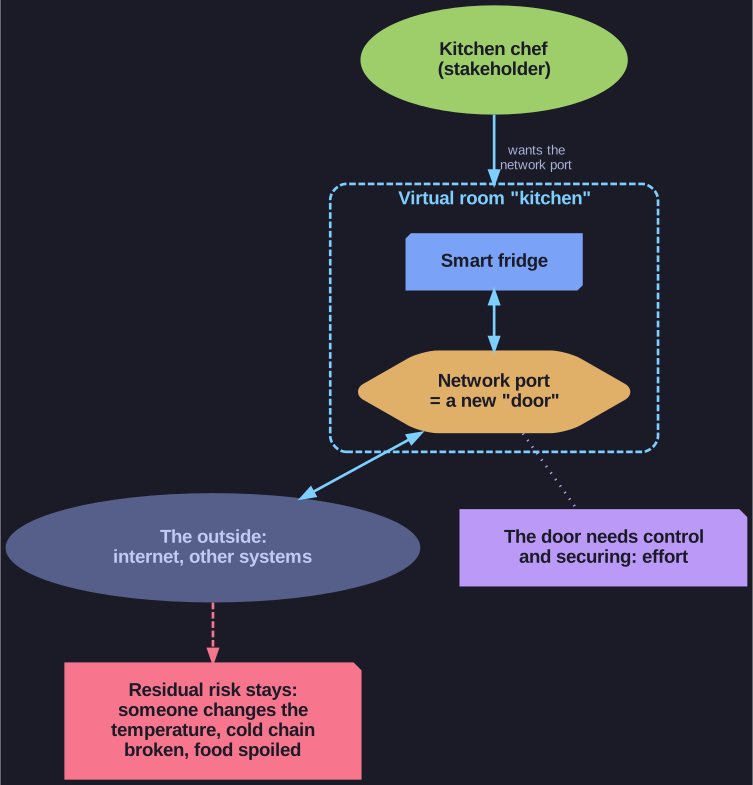
* A network port is a door into the kitchen: it must be guarded, and some risk stays even then. *
The set-up: a cheese dairy's kitchen chef bought a smart fridge and asked the network admin for a network port, so the fridge can talk to the vendor's app and server. The architects chose to keep the fridge without a network (the option with the lowest IT security risk). The chef is the stakeholder who has to accept that decision, and he is not a security expert.
So the explanation avoids LANs, proxies and DMZs and uses an image the chef already understands:
- The door: with a network port, the virtual room "kitchen" gets a door to the outside.
- Guarding the door: that door must be controlled and secured, and that is ongoing effort.
- Residual risk: even a guarded door can be opened by someone who should not. Here the example is concrete and in the chef's own domain: a manipulated temperature breaks the cold chain and the food has to be thrown away, which is exactly the outage the new fridge was bought to prevent.
Go deeper:
 Cold chain — Wikipedia — why an unbroken temperature range matters for food safety.
- Residual risk — Wikipedia — the risk that remains after controls, which a stakeholder must knowingly accept.